
Is Your Online Casino at Risk From the NGINX Flaws?
The web just got another wake-up call. Researchers revealed two critical flaws in NGINX, the web server that routes traffic for more than 225 million websites. On affected servers, attackers can take control without a password. The bigger surprise: one flaw had been hiding in the code since 2015. It took AI tools and five separate research teams to find it.
For online casinos, congratulations: you’re probably affected. NGINX rarely sits in one place. It runs landing pages, guards the payout, routes game launches, and protects admin panels. Passwords, ID documents, and payouts all pass through it. If attackers take over that server, they don’t need to break in. They’re already inside.
This playbook shows where NGINX sits in a casino platform, what to fix first, and how to keep players and partners confident during the update.
Both flaws live in HTTP/2, the feature that helps pages load faster. Any casino running NGINX with HTTP/2 switched on is exposed until it updates. The fix is already out, and switching HTTP/2 off works as a stopgap.
Why an NGINX Hack Hits Online Casinos So Hard
NGINX is almost everywhere. Roughly one in three websites runs on it. That reach is the problem: one popular piece of software sits in front of thousands of businesses, so one flaw becomes everyone’s flaw. In a casino, a single NGINX server can stand in front of several systems at once. Break that one server, and every system behind it is exposed.
How Attackers Could Take Over a Casino Server
- The first flaw is a mix-up. NGINX can close a connection while a player’s request is still using it. An attacker who keeps the server busy enough can cause this on purpose. It mostly affects servers that pass traffic on to other systems, like the systems that process online casino payments and withdrawals, or game providers.
- The second flaw is a counting mistake. NGINX keeps track of how much data it’s allowed to send. An attacker can confuse that count, and NGINX starts reading and writing in places it shouldn’t. Even a simple landing page can be affected.
Either way, the attacker could end up running their own commands on the server, even if your own code is clean and your casino website design is built for speed and security.
How Fast iGaming Platforms Need to Move
Earlier this year, another NGINX flaw was attacked just days after its fix came out. PHP2Shell was attacked within hours. No attacks on these new flaws have been reported yet, but in iGaming security, the gap between a fix and an attack tends to close fast. And you can’t patch a server you don’t know you have.
NGINX usually turns up in more places than the tech team expects. Each spot protects different data and has a different owner, so mapping them shows both what to fix first and who should fix it.
Casino Platform Risks, Stage by Stage
The first flaw puts the middle rows at the highest risk, because those servers pass requests on to payment and game systems. The second flaw can affect every row.
The NGINX Copies Nobody Remembers
The table covers the servers your team knows about. These are the ones it often forgets:
- Old setups that still run. A server set up years ago can keep the NGINX version it came with, and nobody updates it.
- Cloud systems. Many cloud platforms use NGINX behind the scenes to send traffic to the right service.
- Hosting packages. Some hosting plans install NGINX automatically, so your team may never have chosen it.
- Tools from vendors. Some products you buy come with NGINX already inside.
If your team says “we don’t use NGINX,” ask them to check again.
What to Ask Game Providers and Payment Partners
Your map isn’t complete until it includes your partners, from game providers to the iGaming agency that builds and hosts your casino website, because their servers connect to yours. Ask them three things: Is NGINX in front of our connection? Is HTTP/2 switched on? Have you installed the fix? If you’re a game provider, send your answer before operators have to ask.
With the full map in hand, you can start fixing without taking your casino offline.
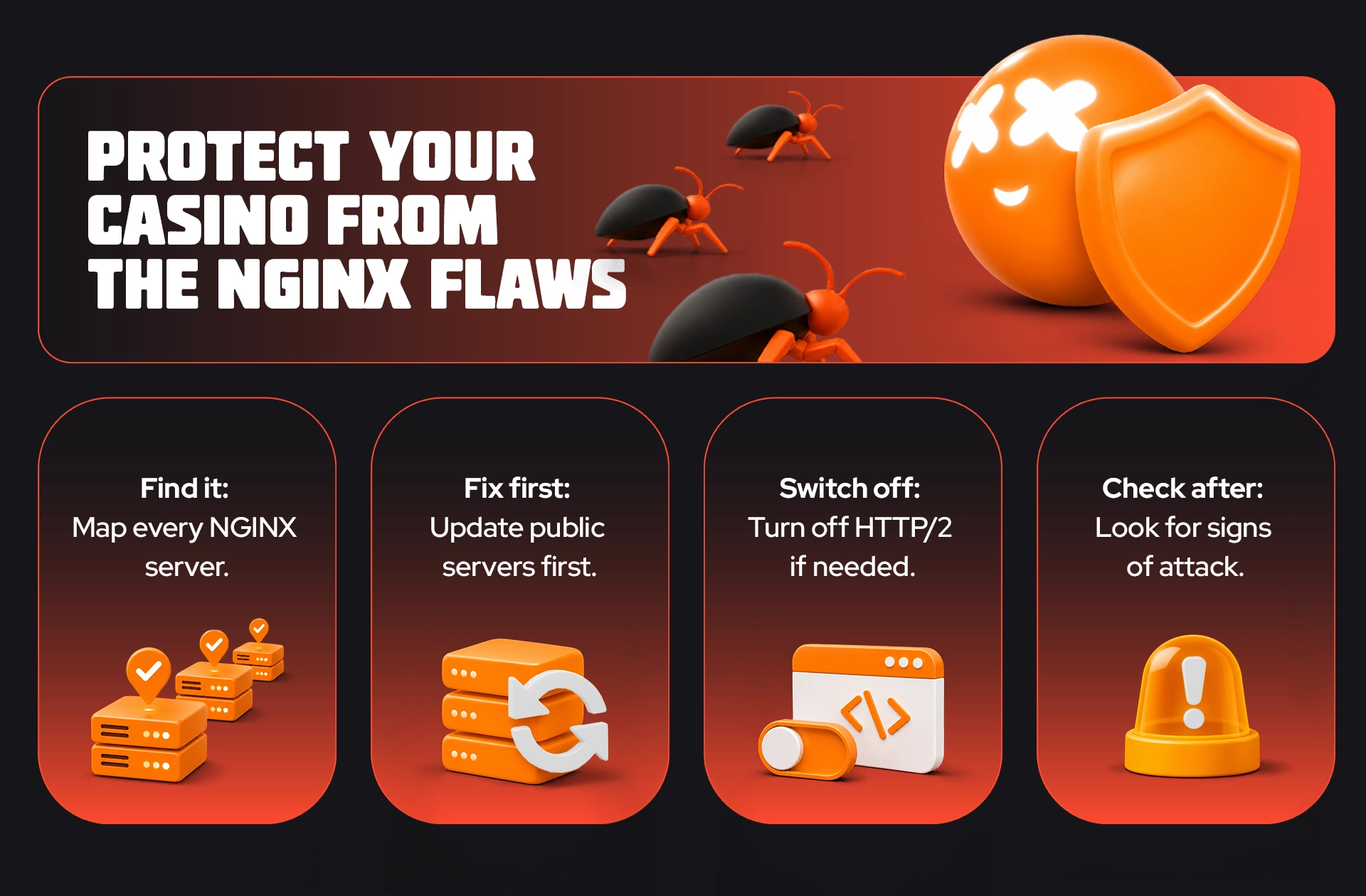
Update in order of risk, use HTTP/2 as a temporary off switch where you can’t update yet, and then confirm nobody got in before the gap closed.
Which Casino Servers to Update First After the NGINX Flaws
- Servers the internet can reach with HTTP/2 on. Attackers can get to these first.
- Servers in front of the wallet and game connections. These carry the most valuable traffic.
- Internal servers. They still need the update, just after the others.
The fixed NGINX versions are 1.30.7 and 1.31.9. NGINX Plus users need F5’s matching release.
How to Switch Off HTTP/2 on a Live Casino
Turning HTTP/2 off blocks both flaws, but pages may load a little slower. Before you do it:
- Test game loading, mobile apps, live dealer streams, and payment pages.
- Avoid big match nights and online casino bonus launches like free spins drops or reload offers.
- Tell support and product teams first, so a small slowdown doesn’t become a flood of tickets.
After the change, make sure NGINX has fully restarted. Old NGINX processes can keep running in the background with the old settings until they finish their work. Switch HTTP/2 back on once the update is in.
Signs That Attackers Targeted Your Casino’s NGINX Servers
None of these prove an attack, but each one deserves a closer look:
- NGINX crashing and restarting for no clear reason
- NGINX starting programs it never normally runs
- Connections that stay open unusually long and keep asking for more data
Testing Your Casino After the NGINX Fix
An update closes the gap, but it doesn’t remove anything an attacker left behind. Check for hidden backdoors and unknown accounts, then run an [iGaming penetration test] to confirm the fix holds. Going forward, build iGaming security checks that cover your servers, not just your games and apps, so the next flaw doesn’t catch you off guard.
While your team works through all this, players are still logging in, depositing, and playing.
Players rarely notice a patch. They notice a slow payout, a game that won’t load, or a strange email asking them to “verify” their account. How you handle those moments decides whether they stay. That’s what player retention in iGaming really comes down to: keeping players through the times that test their trust.
Tell Players What’s Happening Before They Notice
If you need a maintenance window, use a branded page with a clear return time, not a blank error screen. If a tournament or time-limited bonus overlaps with the work, extend it. Players forgive a short pause much faster than a lost bonus.
Protecting Casino Players From Phishing
Security headlines are perfect cover for phishing. Attackers copy your logo and send “reset your password now” emails while the news is fresh, often pointing players to fake casino apps and clone sites built to look like the real brand. Keep your sender address, design, and tone exactly the same as usual so fakes stand out. Remind players that you never ask for passwords by email.
Casino Security Updates for Partners and Regulators
Send partners a short note covering what was affected, what you’ve fixed, and what they need to do, which is often nothing. Ask your compliance team whether any regulator needs to be told.
Patching servers and calming players are two different jobs, and they work best when they’re planned together. GameGuardz tests casino platforms, APIs, and servers the way an attacker would, so gaps like an unpatched NGINX server get found and fixed first. BetBoyz designs the brand, UX, and CRM that keep players confident through every update, maintenance window, and security headline. Let’s talk!
Deliver seamless gaming experiences with intuitive UI/UX design. Betboyz ensures user-friendly interfaces that keep players engaged and satisfied.
The NGINX flaws show that secure code alone doesn’t make a secure casino. The software in front of that code carries every login, deposit, and payout, and one weak spot there exposes everything behind it.
The casinos that handle this well don’t panic. They know where NGINX runs, including in partner and vendor systems. They update in order of risk. And they keep players and partners informed, so a security fix never turns into a trust problem. AI is helping people find old bugs faster, so the next flaw won’t wait a decade to surface. The habits that handle this one will handle that one too.