Fake Casino Apps and Clone Sites: How to Protect Your iGaming Brand
Cybersecurity in iGaming usually focuses on the platform itself, but some of the most damaging attacks happen outside it: fake casino apps and clone sites built to look exactly like the real brand. A scammer copies the logo, login page, and cashier, then spreads the fake through search ads, social posts, and messaging apps.
Players who trust the brand enter their login details, make deposits, or upload ID documents without noticing anything is wrong. The money goes to the scammer, but the complaints, support tickets, and lost trust land on the real operator. Copying visuals takes very little effort, which is why protection depends less on how the brand looks and more on how easily players can verify it.
This article explores how casino brands get cloned, how phishing sites reach players, which brand elements are harder to fake, and how to find and remove fake copies.
Scammers clone casino brands by copying the website onto lookalike domains, creating fake social and messaging accounts, and repackaging the real mobile app with hidden code. Most clones aim for one of three things: player login details, deposits sent to the scammer, or personal and casino payment data collected through fake sign-up forms.
Casino brands are worth copying because players already trust them with money. A clone borrows that trust and skips the hard part of earning it.
The main types of clones
- Lookalike domains: addresses that swap a letter, add a hyphen, or change the ending, like .bet instead of .com. This is called typosquatting. Some use characters from other alphabets that look identical, such as a Cyrillic “а” in place of a Latin “a”.
- Full casino site copies: free tools download the real site’s code, images, and styles and rebuild it on a new domain within minutes, with the login and cashier rewired to the scammer.
- Fake social and messaging accounts: profiles using the brand’s name and logo to offer “exclusive” bonuses or “support” on Telegram, Instagram, or WhatsApp.
- Repackaged apps: the real Android app (APK) is unpacked, injected with code that captures logins or redirects payments, re-signed, and shared as a download.
- Fake affiliate pages: sites posing as independent reviews that send traffic straight to a clone.
Each type lands on a different team: domains with legal, social accounts with marketing, the app with product, and the scammed player’s complaint with support.
A clone only works if players find it, and that’s the job of phishing.
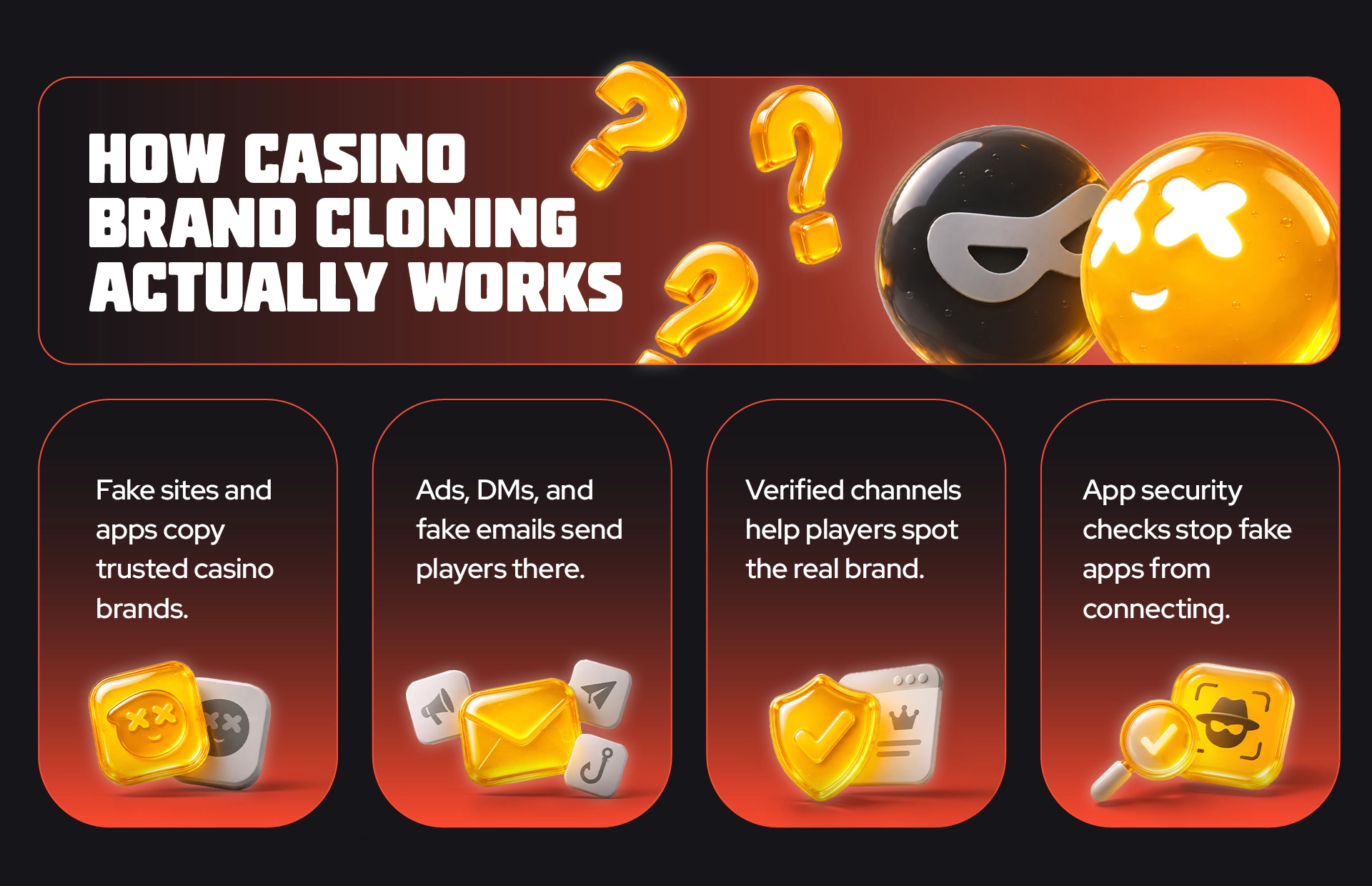
Casino phishing sites are fake pages built to look like an operator’s login, cashier, or bonus page. Players usually reach them through search ads, social media posts, messaging apps, or spoofed emails promising a bonus. Once a player enters their login or card details, the scammer can take over the account or charge the card.
How players land on phishing pages
- Paid search ads: scammers bid on the brand name, so the fake link can appear above the real site.
- Social comments: free spins or deposit matches posted under the brand’s own content, where players already expect offers.
- Direct messages: fake “VIP managers” or “support agents” who reach out first with a time-limited bonus.
- Spoofed emails and SMS: messages that copy the brand’s real CRM templates, sender name, and tone.
- SEO clone pages: fake pages built to rank for searches like “[brand] login.”
What phishing pages collect
More than a password. Many pages pass details to the real site as the player types, so a 2FA code gets used within seconds, before it expires. Fake cashiers capture card numbers, and fake KYC steps ask for passport scans and selfies that can be reused elsewhere. Stolen logins like these are one of the main entry points for account takeover.
For iGaming CRM and marketing teams, consistency is the strongest defense. When real messages always come from the same sender names, follow the same format, and use a known set of channels, a fake stands out. Bonuses announced only in DMs train players to trust exactly the kind of message scammers send.
That makes the brand itself part of the protection, starting with the elements that are hardest to fake.
A casino’s logo, colors, and layouts can be copied in minutes. The brand elements that hold up are the ones scammers can’t fake without access to the operator’s systems: a consistent domain and channel structure, a recognizable voice with clear contact rules, verified brand assets, and personal touches only the real account can show.
Strong iGaming branding goes beyond recognition. Players should be able to verify the brand, not just recognize it.
Brand elements that help players spot the real casino
- Domain and channel naming system: domains, mirror links, app listings, and social handles follow one published pattern. When every touchpoint follows the same rule, a lookalike breaks it.
- Brand voice with contact rules: a tone of voice guide that also defines what the brand never says, such as asking for a password or pushing a deposit in DMs. Repeated in onboarding and the help center, these lines become part of how players know the brand.
- Verified brand assets: the logo shown next to genuine emails through BIMI, and verified badges on social profiles and Telegram channels. The logo itself carries proof.
- A live licence seal: designed into the footer as a trust element and linked to the regulator’s own register.
- Personalized brand moments: a security phrase the player picks at sign-up, shown on the login page and in emails, plus VIP tier or loyalty balance in messages. A clone can copy the template but not the player’s data.
- Motion and interaction: lobby transitions, custom animations, and app micro-interactions are harder to rebuild faithfully than static pages, and players notice when they’re missing.
- Built into brand guidelines and CRM templates from the start, these cues read as part of the identity, not a security notice.
Websites and emails are only half the picture. The casino app is the other big copy target.
Casino apps can be cloned by downloading the real app, unpacking it, adding malicious code, and publishing the modified version under the same name and icon. App protection makes this harder through code obfuscation, tamper and integrity checks, server-side verification that the app is genuine, and regular security testing of the app and its APIs.
Why casino apps are exposed
In markets where app store availability is limited, operators often distribute Android apps as direct APK downloads. Players get used to installing from outside the store and tapping through “unknown sources” warnings, so a fake APK raises no extra suspicion.
Protection measures worth considering
- Code obfuscation: renames and scrambles the app’s code so it’s harder to read, edit, and rebuild.
- Tamper and integrity checks: the app checks its own signing certificate and files against the original and stops running if anything has changed.
- Server-side app verification: the backend uses Google Play Integrity or Apple App Attest to confirm requests come from a genuine, unmodified app, and blocks logins and deposits that fail.
- Certificate pinning: the app only connects to servers carrying the operator’s own certificate, so a fake backend can’t intercept traffic.
- Secure token storage: session tokens kept in Android Keystore or iOS Keychain, not in plain files a modified app can read.
- One official download page: linked from the main site, with the current version listed so support can confirm a genuine install.
Built into brand guidelines and CRM templates from the start, these cues read as part of the identity, not a security notice. That’s where partnering with BetBoyz helps: we design the identity system, voice, and player communication that make the real brand easy to verify, while GameGuardz tests whether the logins, apps, and APIs behind it hold up against impersonation.
Even a well-protected casino brand still gets copied, so the last layer is finding fakes fast and getting them removed.
Get a full-cycle operational support for your iGaming business from CRM to Media Buying & PPC.
Fake casino apps and clone sites work because they borrow the trust the real operator has already earned. Scammers copy the look, reach players through search ads, DMs, and spoofed emails, and collect logins, deposits, and ID documents along the way.
Protection comes in layers. Brand elements like a clear domain system, verified assets, and personal security cues help players verify the brand, not just recognize it. Integrity checks and server-side verification make the app harder to repackage. Ongoing monitoring and fast takedowns keep fakes from reaching more players. Together, they turn the brand itself into the first line of defense.