
Churn Prediction in iGaming CRM: Spotting At-Risk Players
Every iGaming operator’s CRM holds the earliest signs that a player is about to go quiet: fewer sessions, longer gaps between deposits, a shift away from the games they usually play. Churn prediction turns those signals into a score. The CRM can act on that score before the player actually leaves.
A churn score should translate into automated retention actions like win-back offers and reactivation emails. These should be tiered by how at-risk a player really is. But iGaming CRM teams still need to review what the model flags before those offers go out to ensure accuracy and relevance.
A score can’t always tell a genuinely disengaging player from one on a quiet stretch. Measuring whether the setup works matters just as much as building it.
This article walks through what churn looks like in CRM data, how automation should respond to a churn score, why human review still matters, and the metrics that show it’s paying off.
Churn rarely starts with a closed account. It starts weeks earlier, in small shifts the iGaming CRM already records: fewer sessions, wider gaps between deposits, movement away from a player’s usual games. Noticing these early signals helps CRM teams spot potential churn before a score is generated, making early intervention more effective.
The early warning signs
- Session frequency drops: fewer logins per week, or shorter sessions than the player’s own baseline.
- Deposit gaps widen: more time passes between deposits than the player’s normal rhythm.
- Games shift: a player moves off their favorites without settling into new ones, which frequently signals disengagement instead of exploration.
Why this matters for CRM and Data teams
These symptoms show up directly in activity logs, long before any score gets generated. A CRM manager scanning session counts or deposit timestamps can flag a player drifting away well before a model ever runs, which makes this data a useful starting point on its own. It’s also where “at risk” gets defined in practical terms, since what counts as a worrying gap or a meaningful drop-off looks different for a high-frequency slots player than it does for someone who deposits monthly.
That same activity is also the raw material a churn model works from. Session, deposit, and gameplay patterns become the behavioral features that produce a churn score, so that score’s quality depends entirely on how well those early symptoms are captured in the first place.
CRM input matters here too. Knowing which signals actually preceded real churn in the past keeps the model tied to genuine player behavior, rather than to patterns that merely look statistically convenient.
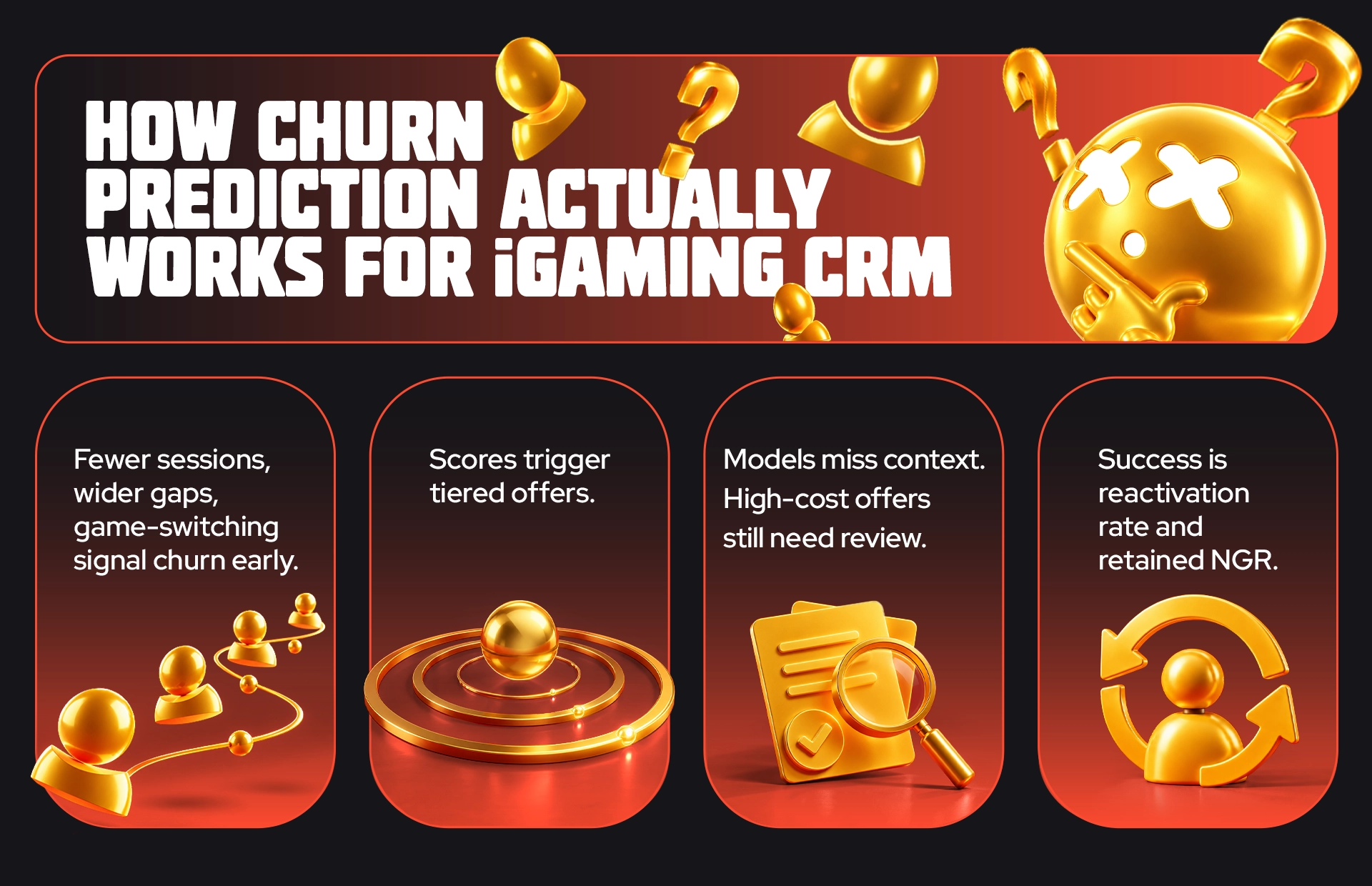
A churn score is only useful once it maps to a specific action: win-back offers, reactivation emails, or a personalized casino bonus nudge, tiered by how far along the risk curve a player sits. Early-warning players need a lighter touch than high-risk or dormant ones; treating every flagged player the same wastes both budget and goodwill.
Fitting the response to the risk tier
- Early-warning players get a light touch: a personalized email or a small, relevant promotion, nothing that reads like a rescue attempt.
- High-risk players get a stronger win-back offer, timed to land before their typical deposit gap closes for good.
- Dormant players need a different kind of campaign altogether, built for someone who’s likely already checked out mentally, not a repeat of the early-warning nudge.
The tiering is what makes the automation worth having. A single blanket “at-risk” trigger, sent the same way to everyone the model flags, is the fastest way to waste the score’s precision. It spends budget on players who barely needed convincing while under-serving the ones about to leave for good.
But tiers are still built on a score, and a score is still a guess, one that can misread a player who isn’t actually drifting away at all.
A churn model reads patterns, not context. It can’t tell the difference between a player who’s genuinely disengaging and one who’s traveling, in a seasonal lull, or a VIP quietly testing how the operator treats a quiet month. Human review before high-cost interventions is what keeps automated player retention from damaging the relationships it’s meant to protect.
Where the model tends to miss context
- Seasonal or life-event lulls such as a slow month, a holiday break, or a busy work stretch can look identical to withdrawal in the raw data.
- VIP or high-value players whose activity dips get read the same way as a casual player’s, even though the retention economics are nothing alike
That’s not a flaw to fix by adding more data; it’s a limit worth designing around. A review checkpoint before the highest-cost offers go out doesn’t mean manually checking every flagged player; it means gating the segments where a wrong call is expensive, like VIPs or players who’d receive a large win-back offer.
This is the sharpest trade-off in the whole system: full automation scales retention outreach, but it also scales the cost of every misread signal. And a misread doesn’t just waste an offer; it shows up later, in the numbers meant to prove the whole setup is working.
The real measure of a churn-prediction setup is reactivation rate and retained NGR, not how many offers went out. Sending retention offers to players who were never actually at risk inflates volume, invites casino bonus fatigue, and quietly erodes the precision the model was built to provide.
The metrics worth tracking
- Reactivation rate: the share of flagged players who actually return to their prior activity level after a trigger
- Retained NGR: the margin genuinely preserved by iGaming retention efforts, not just a count of reactivated accounts
- Offer volume: useful to track, but only as a cost metric, never as a sign of success
Over-triggering has a real cost. False positives, such as players flagged as at-risk who were never really leaving, quietly corrupt trust in the model, and train players to expect an offer the moment their activity dips even slightly. Confidence thresholds and suppression rules for recently active players are what keep the trigger system precise instead of merely wide-reaching.
Reactivation rate and retained NGR work best when viewed together, on a recurring cadence, with over-triggering treated as a signal to tune the model rather than a marketing volume target. In retention automation, precision beats reach: a smaller, well-targeted trigger list will outperform a wide one padded with players who were never going anywhere.
Getting that balance right with enough automation to scale, enough review to stay precise is where most churn-prediction setups actually live or die, and it’s the kind of tuning BetBoyz’s CRM team works through with operators directly, from signal design to the metrics that prove it’s working. So get in touch to talk through your CRM setup.
Boost player engagement with tailored CRM solutions. From onboarding to retention, Betboyz ensures seamless management and personalized experiences.
Churn prediction only pays off when every piece works together: the right signals feed the model, tiered triggers act on the score, human review catches what the model can’t see, and metrics measure retained margin instead of send volume.
Get those four pieces aligned, and retention stops being a reactive scramble and becomes a system the CRM can actually rely on, one that catches a player drifting away weeks before they’d have shown up as a lost account, and spends the budget where it actually changes the outcome.
That’s the real shift churn prediction offers: not more offers going out, but the right ones, at the right moment, to the players who were genuinely about to leave.