
PHP2Shell and iGaming: The Impact and How to Protect Your Business
October 2026 delivered one of the biggest security shocks the web has seen in years. Two critical flaws were found in PHP, the language running a huge share of the internet, and they handed attackers a master key: full control of a website, no login needed. The flaws were named PHP2Shell. AI helped researchers uncover them, and AI helped attackers strike back. Within hours of going public, the attacks had already started.
For online casinos, this was a direct hit to everything that matters. Real money, ID documents, and player accounts move nonstop between casino sites, game integrations, CRM tools, and admin panels. Leave just one of them unpatched, and the whole operation is exposed.
This BetBoyz playbook walks through where operators are most at risk, how to protect each part of the platform, and how to keep players confident when the next big security story breaks.
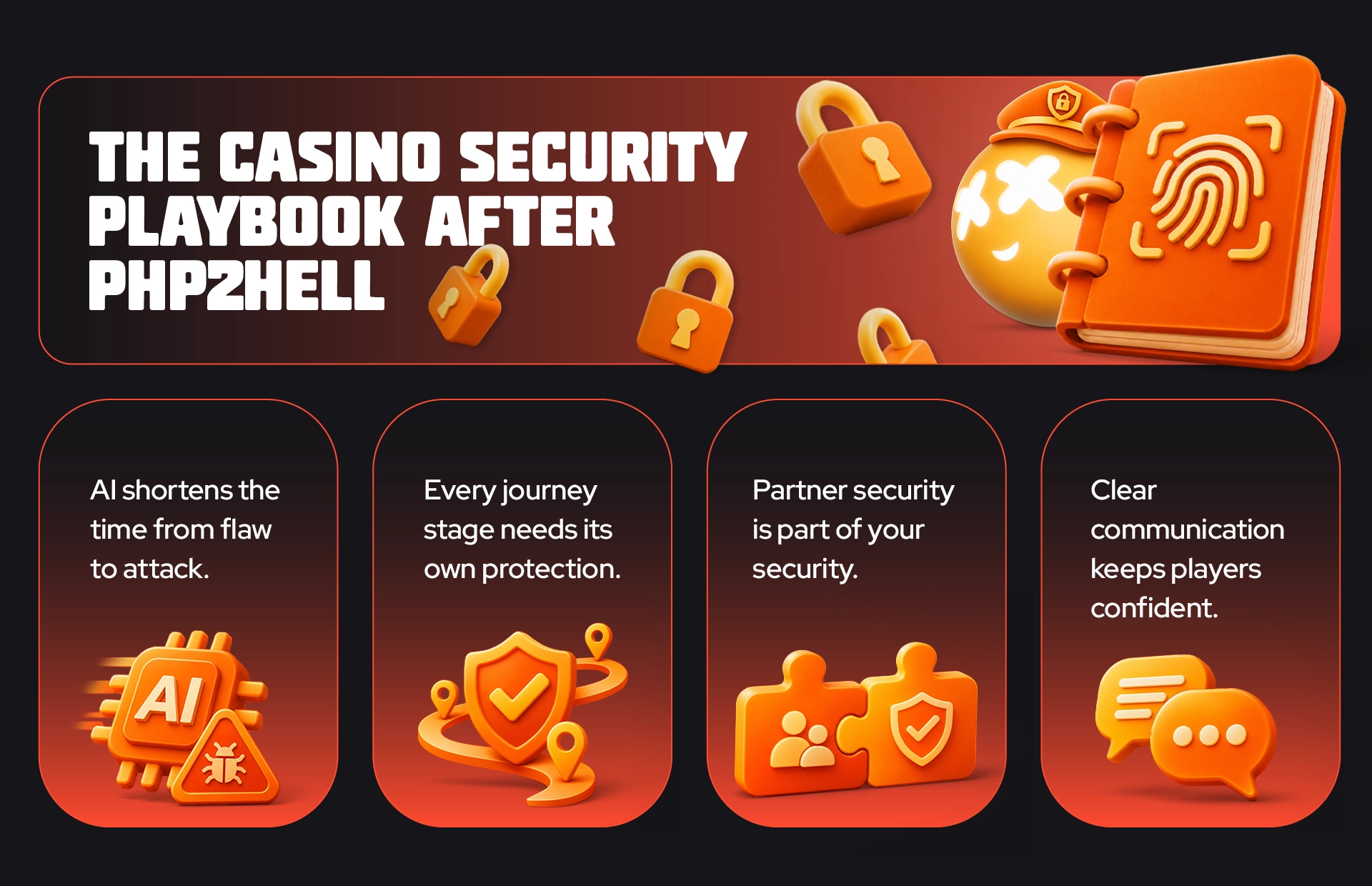
To understand why PHP2Shell caused such alarm, start with how much of web runs on PHP. That’s why PHP2Shell hit so hard. The two flaws sat in PHP itself rather than in any one app, so almost every setup using PHP to serve web pages was exposed. Both scored a critical 9.2 out of 10. And the PHP project rushed out fixed versions on October 21, and the official security announcement made the message clear: update now.
For online casinos, the bigger lesson is that connected platforms carry connected risk, and AI is shortening the time between a flaw being found and being used in attacks.
How AI Is Changing the Speed of Cyberattacks
The bug behind PHP2Shell had been hiding in plain sight for years. Then AI changed the game. Flaws that once took experts weeks to figure out can now be understood and turned into real attacks far faster. Weak spots that used to seem too hard to use are suddenly fair game.
And the speed doesn’t stop there. The moment a fix goes public, attackers can use the same AI tools to work out what it repairs and hunt down every site that hasn’t updated yet. As these tools get cheaper and easier to use, attacks can run at massive scale, and online casinos are an obvious target.
What a PHP2Shell Attack Could Cost an Online Casino
When attackers break in, the damage doesn’t stay on the server. For an online casino, a security issue turns into a crisis fast. It can show up as:
- Downtime that freezes deposits, gameplay, and withdrawals
- Leaked keys that hand attackers access to payment or game integrations
- Phishing emails sent to players in the casino’s name
Each of these hits revenue, player trust, and the brand all at once. That’s why security can’t sit with the tech team alone. It needs business and technical teams working side by side.
An online casino’s attack surface follows the player journey, from the first click on a casino site to the final withdrawal. Each stage holds something worth stealing: traffic, identity documents, payment access, or staff permissions. Mapping security by stage shows exactly what needs protecting and who is responsible for it.
Online Casino Security Risks Across the Player Journey
At every step, players hand over something new: their attention, their identity, their money, and their trust. And every one of those is exactly what attackers are after.
| Journey stage | What’s at risk | What an attacker could do | Owning team |
|---|---|---|---|
| Acquisition | Casino sites, landing pages, blogs | Redirect visitors, inject spam content, host clone login pages | Marketing |
| Onboarding | Sign-up forms, KYC uploads | Access ID documents and session data | Product, compliance |
| Deposits | Payment callbacks | Steal payment API keys, tamper with payment flows | Payments |
| Gameplay | Game integrations, aggregator APIs | Misuse integration keys, interfere with balances | Platform, product |
| Retention | CRM, email and loyalty tools | Export player lists, send official-looking phishing | CRM |
| Withdrawals and back office | Admin panels, payout tools | Change payout details, take over staff accounts | Risk, operations |
Some stages are riskier than they look:
- Acquisition is the stage most casinos forget to protect. Casino sites and campaign landing pages are usually built fast, run on popular content platforms, and sit outside the main platform’s security routine. And because they carry the brand, one hacked page can send players straight to a clone site that looks exactly like the real casino.
- Onboarding holds some of the most sensitive data a casino collects. KYC uploads such as passports and utility bills need careful storage and strict access, because once they leak, they can’t be “reset” like a password.
- Deposits and gameplay run on trust between systems. When a payment provider or game aggregator sends a message to the platform, the platform has to confirm that the message is genuine before it changes a balance.
- Withdrawals are where attackers go straight for the money. Changing a player’s payout details or breaking into a staff account is often the final move in an account takeover.
Third-Party Risks such as Game Providers and Payment Processors
A modern casino is built with partners. Casino game studios, aggregators, payment processors, and KYC services all connect to the platform, and many of them hold keys, data, or access of their own.
Here’s the thing: a partner’s security is your security. If a partner gets hacked, attackers could use its connection to reach your platform or your players, even if your own code is spotless.
The strongest partnerships set clear expectations from day one:
- Proof of testing. Ask vendors when their systems were last security tested and how findings were resolved.
- Patching habits. Check how quickly they patched after major disclosures like PHP2Shell.
- Limited access. Give each partner only the access it needs, with its own keys, so one connection can be changed without affecting the others.
- A named contact. Know who to call on their side the moment something goes wrong.
These conversations are easiest to have during onboarding, before there’s a problem, when expectations are being set for both sides.
Security Questions Every Casino Leadership Team Should Ask
Security decisions don’t need to start with technical detail. Three simple questions show leadership exactly where the platform stands:
- Which systems and vendors touch player money or data? This includes the obvious ones, like the payment, and the easy-to-miss ones, like an old campaign site or a reporting tool.
- When was each of them last tested? A system that changed recently, or hasn’t been reviewed in a while, is the first place to look.
- Who owns the fix? When a weakness is found, it should be clear which team updates the system and how fast.
Clear answers to these three questions turn security from a vague worry into a real plan.
When an incident hits, players are watching. They judge the casino brand by how it communicates as much as by how fast it fixes the issue. A calm, consistent response tells them their accounts are in good hands and makes the recovery feel under control, not chaotic.
How to Handle Casino Downtime Without Losing Players
- Show a branded maintenance page with an expected return time.
- Pause or extend time-limited promotions that overlap with the downtime.
- Plan these screens before you need them as part of your iGaming UX/UI design.
How to Protect Casino Players From Phishing Emails
- Keep one sender address, one email design, and one tone, so fakes stand out instantly.
- Add a standing line to emails: “We’ll never ask for your password.”
- Manage every campaign through one iGaming CRM to keep messaging aligned.
How to Communicate a Security Incident to Players and Partners
- Cover three points in plain words: what happened, what’s been done, what to do next.
- Have support scripts and partner briefs ready before the crisis hits.
- Ask compliance to confirm any regulator notification duties.
How Visible Security Builds Player Trust
- Highlight 2FA, login alerts, and payout-change alerts front and center in the player account.
- Treat these features as part of your iGaming branding, not just a buried settings page.
PHP2Shell won’t be the last wake-up call. As AI helps both researchers and attackers work faster, the gap between a flaw going public and being attacked will keep shrinking.
For online casinos, that makes preparation the real advantage. Teams that already know their systems, partners, and responsibilities can treat the next major update as routine work instead of a panic.
The same goes for players. A brand with its communication ready stays calm under pressure, and that calm is often what players remember long after the fix is done.
Security and trust work best as one plan: the platform stays protected, and players stay with a brand that looks after them.
Let’s build both. GameGuardz tests your platform, apps, and APIs the way an attacker would, so you can fix weak points first. BetBoyz designs the brand, UX, and CRM that keep your players confident through every update. Let’s talk!