The True Cost of Generic Casino Branding
In many cases, the most expensive part of running a casino brand is the branding itself, and it’s easy to miss. Generic casino branding can cost you money in at least five clear ways. It makes you spend more to win each player, because the bonus has to do all the convincing on its own. It makes players leave faster, because they never form a real connection to the brand. It slows down trust, right when a first-time visitor is deciding whether to deposit. It makes every marketing channel work harder for weaker results.
This article breaks down each cost, gives you a simple five-point checklist to see if your brand is the problem, and shows how the math plays out on a real casino brand investment.
Casino brands start to look alike because of three things working together: industry conventions everyone follows, a reluctance to take risks, and branding services that reuse the same visual templates across dozens of clients. Add in how fast the market has grown since 2020, and following the same look becomes the easiest path to take.
The three forces behind convergence:
- Conventions: casino naming patterns and color palettes built around navy-and-gold or neon-and-black became default starting points rather than active choices.
- Risk aversion: when budgets are tight and timelines are short, copying what already works feels safer than testing something unproven.
What it looks like in practice:
- Generic slot lobby imagery that’s hard to distinguish from competitor to competitor
- Repetitive color palettes across markets
- A naming convention that has become the default rather than a choice
Most operators sense their casino brand blends in. The reason it stays that way usually is that the cost of staying generic doesn’t show up anywhere finance teams are trained to look. A casino rebrand is seemingly a visible expense. The cost of not rebranding your casino is scattered across acquisition, retention, and reactivation, where it’s easy to read as “the market” rather than the brand.
Where the cost hides:
- In acquisition reports: a rising cost-per-deposit gets attributed to channel saturation or competitor activity, rarely to brand.
- In retention dashboards: churn gets explained by bonus competitiveness or game catalog, not by whether players ever formed an actual connection to the brand.
- In marketing budgets: when performance softens, the instinct is to add more acquisition spend, since that’s the lever everyone already knows how to pull.
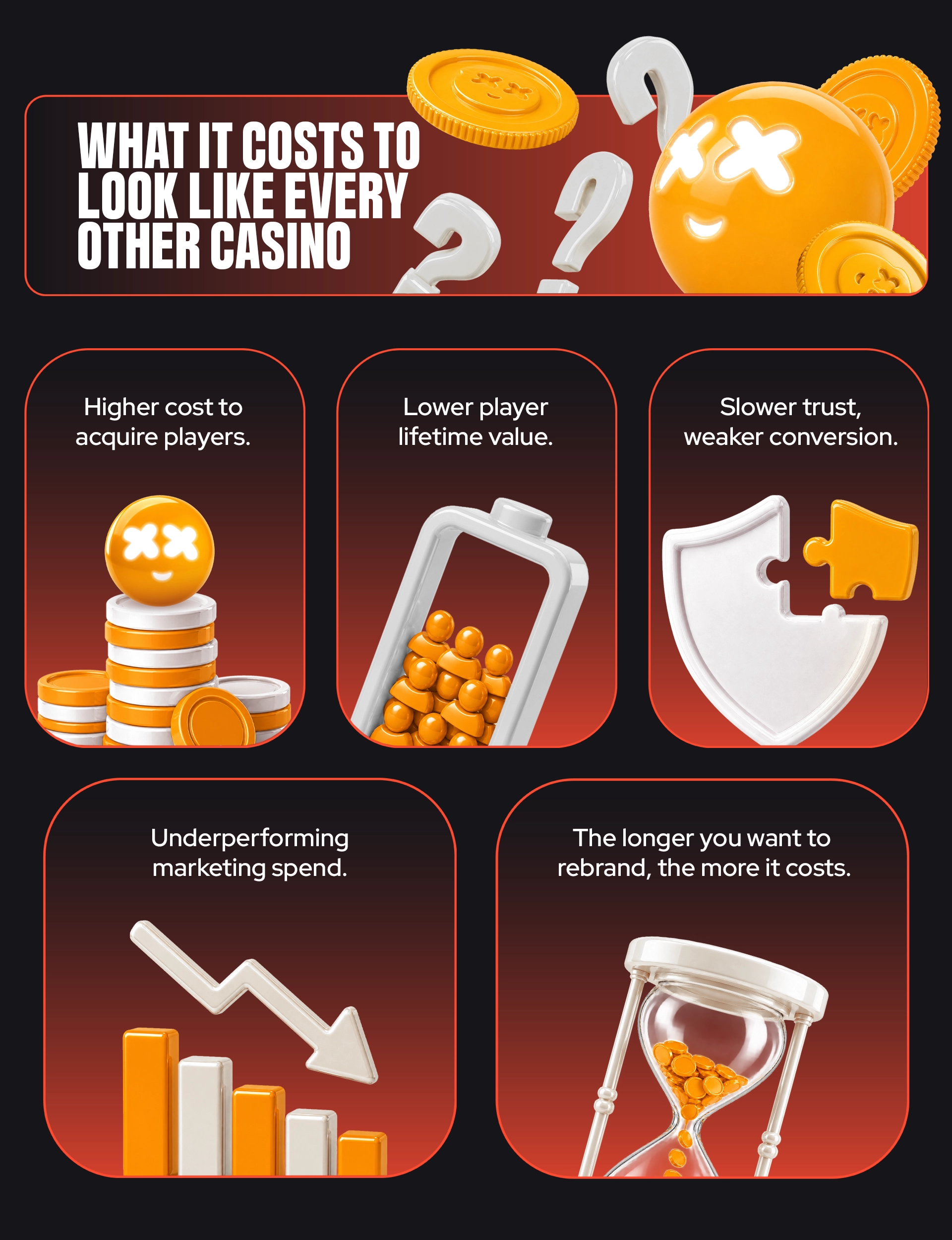
When a casino brand doesn’t differentiate, the bonus has to do the convincing instead. Players comparing similar-looking sites default to whichever one offers the biggest welcome offer, because nothing else gives them a reason to choose. That’s an expensive way to win a player; bonus-led acquisition keeps pushing acquisition costs up instead of letting brand equity carry part of the load.
A recognizable brand identity lowers the bonus threshold needed to convert a comparison-shopping player. The brand does part of the persuasion work the bonus would otherwise have to do alone. In an acquisition environment that’s already getting more expensive across the board, the operators best positioned to absorb it are the ones not relying on bonus size as their only differentiator.
A generic casino brand also struggles to keep players once they’re in. Without a distinct brand identity, the relationship a player forms is with the casino bonus and the game catalog, not with the operator. That relationship is unstable by nature, since both can be matched or beaten by the next site over.
If nothing about the brand itself is memorable, there’s nothing pulling a player back beyond the next promotion, and the next operator’s promotion is one tab away. Retaining a player is consistently cheaper than acquiring a new one, which means every point of avoidable churn carries real financial weight, not just inconvenience.
A player decides whether to deposit within seconds of landing on a site. Generic visual identity gives that decision nothing to go on; no signal of investment, no sense of a real company behind the page, just another interchangeable lobby. Trust gets built somewhere, and if the brand isn’t building it, the player has to find it elsewhere, or leave.
Players can’t audit an operator’s licensing or financial stability in the first ten seconds. What they can read instantly is the visual evidence of care, and that’s exactly what generic branding strips out. A casino brand that looks like a template signals the company wasn’t specific about who it’s for, and that absence shows up directly in how quickly a first-time visitor commits to depositing.
Every channel works harder for a brand with a real brand identity. Affiliates produce stronger content when there’s an actual brand to build around, rather than defaulting to generic. SEO content carries more authority when it reads as belonging to a specific, recognizable operator.
A generic brand turns every channel into the same fight: outspend the next site, since nothing else is winning the comparison. The natural response is to add more budget, which masks the real problem instead of fixing it. The brand isn’t a separate line item from performance marketing; it’s the multiplier sitting underneath all of it.
Delaying a rebrand doesn’t avoid the cost; it just moves it later and makes it bigger. A rebrand done early can follow a focused iGaming branding framework: new identity, clean rollout, minimal legacy to untangle. A rebrand done years in carries everything that’s accumulated since, such as asset migration, player communication, partner and affiliate re-enablement, regulatory notification, and the work of unwinding marketing infrastructure built around the old identity.
Every additional month a generic brand runs creates more of this to eventually undo. The math doesn’t reward waiting.
A handful of signals tend to show up together when brand mediocrity is the real bottleneck:
- Acquisition costs rising even though the channel mix hasn’t changed
- Churn that doesn’t improve when bonuses get more aggressive
- Affiliate creative that consistently underperforms across the network
- First-deposit conversion that sits below what comparable operators see
- Brand-search volume that’s flat or declining year over year
Any one of these can be explained by something else entirely, such as distribution, product fit, payment friction. Two or more together is a stronger signal that the casino brand itself is the limiting factor, not the channels spending against it. Operators less than a year into launch are usually better served finishing the product first; brand mediocrity isn’t yet the primary cost driver at that stage.
Create a standout iGaming brand with Betboyz. From logos to brand identity, we ensure your vision resonates with players and leaves a lasting impression.
Generic branding is most importantly a financial problem, distributed quietly across acquisition, retention, and channel performance until it reads as “the market got harder.” It didn’t. The brand stopped doing its share of the work, and the rest of the business has been compensating for it ever since.
Suspect your brand is the bottleneck? BetBoyz audits operator brands alongside acquisition and retention data; it’s the clearest way to tell whether brand mediocrity is the real driver, or whether something else is. Send six months of channel data and your current brand assets, and we’ll come back with whether a rebrand is justified and what it would actually move.