How Crash Game UX Differs from Slot UX (And Why It Matters)
Crash games and slot games both live in the casino lobby, both take bets, and both pay out. But sit down to design the UX for one after the other, and the difference hits immediately. The round structure is different, the controls are different, and even the sound has to do a different job.
The player experience, the decision structure, the emotional rhythm of a round all of it works differently. A slot round is something the player watches unfold. A crash round is something the player has to actively manage against a multiplier that won’t wait.
This is about each one having its own logic. Slot UX is built around a satisfying loop. Crash UX is built around a single high-stakes moment. Once that distinction is clear, everything else in this article makes sense.
Let’s walk through it.
Before getting into buttons, phases, and sound design, it helps to establish the one difference that everything else builds on. It’s not about visual style or theme or round length. It’s about whether the player is watching or deciding. That distinction reshapes the entire design brief from the ground up, and it starts the moment the round begins.
Slots are a passive experience. The player taps, the reels spin, something happens. The craft in slot game design is in making that reveal feel incredible: reel stop timing, near-miss tension, win animations that unfold in stages. But the player isn’t making decisions mid-round. They’re the audience.
Crash hands the player a live situation and says: you figure it out. The multiplier is climbing right now. Other people are bailing out. You have no idea when it stops. What are you doing?
Two completely different emotional and cognitive experiences. Which means:
- Slot UX brief = make this loop feel great
- Crash UX brief = make this one tap work perfectly
Everything else flows from that single distinction.
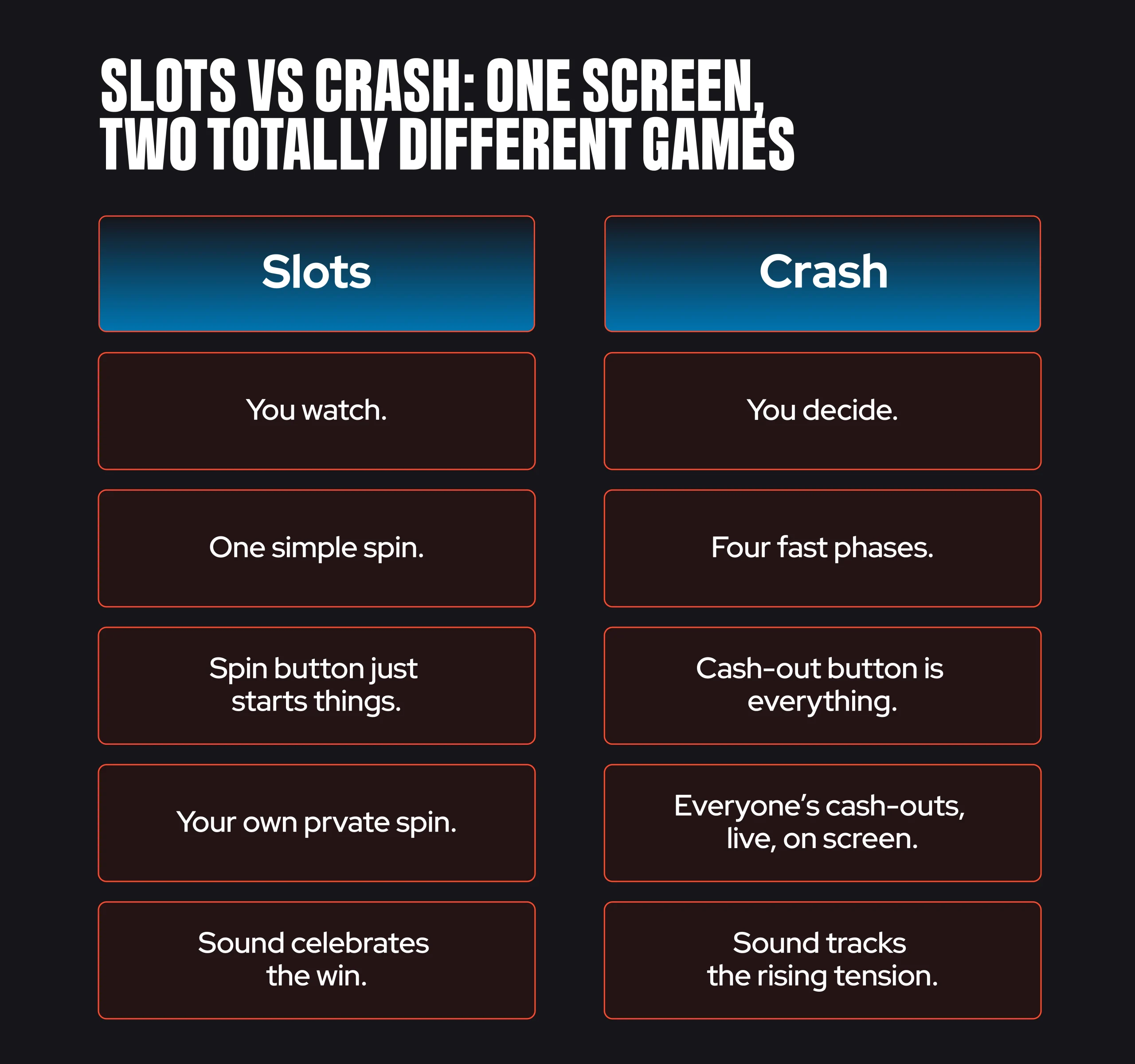
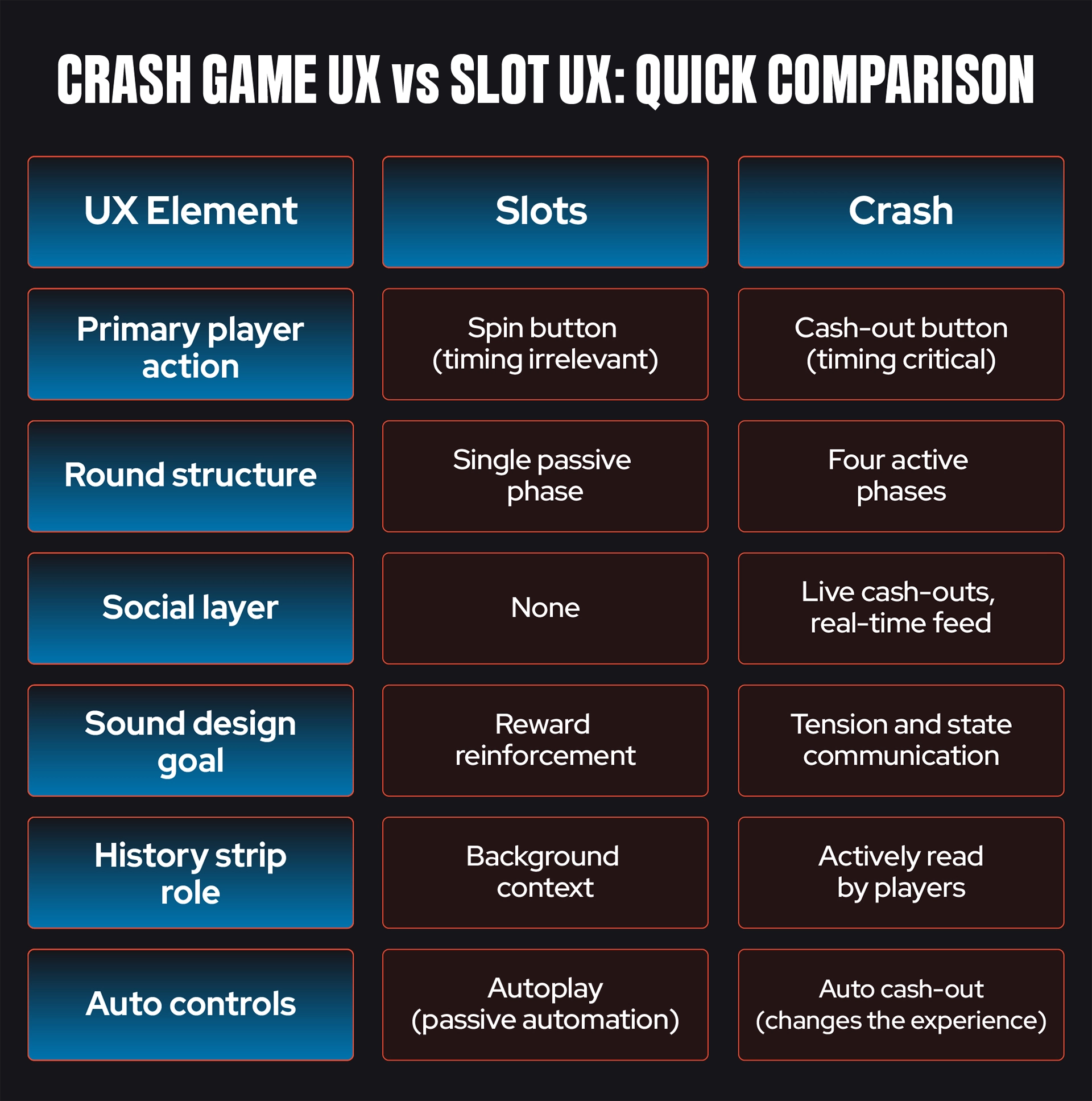
A slot spin is 2–4 seconds. Quick, contained, on to the next one. The UX can afford to be layered and rich because the player isn’t being asked to do anything during those seconds except feel things.
Crash rounds run 5–30 seconds of fully active time, and within those seconds, there are four distinct phases that any serious crash game design has to account for, each requiring the player’s attention to land differently:
- Betting window: calm, open, the previous result still visible. The player is deciding the stake and strategy.
- Takeoff: bets lock, the curve starts moving. The transition has to be completely unambiguous.
- Climb: full attention on the multiplier and the cash-out button. Everything else is noise.
- Crash: sharp end, clear result, immediate reset into the next betting window.
Every format has a primary interaction. In slots, the spin button starts the round; its timing is irrelevant, its job is simply to trigger the sequence. In crash game design, the cash-out button doesn’t just start something. It is the entire game.
The window between a great exit and a bust can be a fraction of a second, which means this button carries more UX responsibility than almost any single element in casino game design.
It has to:
- Respond instantly, with zero perceptible lag
- Be reachable by a thumb in portrait mode on mobile
- Have no confirmation step, no friction, no ambiguity
- Give immediate haptic and visual feedback that it registered
BetBoyz designs the cash-out button as the fixed constraint around which the rest of the UI is arranged. Size, position, tap margin, and haptic response all get deliberate attention. The rest of the screen exists in service of making sure that one tap is always exactly where the player needs it.
Slot sessions are private by nature: your spin, your outcome, your experience. Crash does something structurally different: it puts every active player in the same room. Other players’ cash-outs appear on screen as they happen, turning individual decisions into shared social data. That communal layer is genuinely novel in casino website UX, and it introduces a design challenge that slots simply don’t have.
Players read those live exits, actively anchoring decisions against them, feeling the tension of a room, making choices in real time. The UX challenge:
- The social feed has to be legible at a glance
- It can’t compete visually with the multiplier or the cash-out button
- It needs to feel present without becoming dominant
Crash Game UX Controls That Don’t Have a Slot Equivalent
Slots have autoplay. It automates a passive action and doesn’t really change the experience for the player using it. Crash has auto-cash-out, which is a meaningfully different thing. It removes the real-time decision entirely, sets a target multiplier, lets the strategy run, and skips the live pressure.
For some players, that’s exactly what they want. For others, the live pressure is the entire reason they’re playing.
Where to surface these controls is a call with real downstream effects:
- Too prominent by default – shifts the experience toward passive for everyone, flattens the tension that the format is built on
- Too buried – players who want them for strategy or responsible play can’t find them
Slot audio is built on reward reinforcement. Ascending tones, celebratory fanfares, audio scaled to the size of the payout. It’s a developed craft central to slot design, and when it’s done well, it genuinely elevates the experience across all online casino games.
Crash audio runs a different program entirely, because the emotional logic is different:
- During the climb: low, building tone that grows with the multiplier. Communicates rising stakes.
- At the crash: sharp, definitive, final. Communicates the end of the round clearly.
- Haptics: subtle rhythm during the climb, a distinct hit at the crash point.
The goal isn’t to celebrate. It’s to give the player a real-time audio and physical read on a live situation. Miss the sound design in a crash game, and you’ve removed a functional layer of feedback, not just atmosphere.
Bring your game ideas to life with Betboyz. Our creative team designs engaging, visually stunning games tailored to captivate your audience.
The skill sets overlap, but the logic doesn’t map one-to-one. Slot UX and crash UX are both excellent disciplines. They just answer different questions for different player experiences.
BetBoyz builds across both: crash games designed around the cash-out moment as the primary constraint, slot builds that give the reel reveal and win hierarchy the attention they deserve. Either way, the math, the UX, the sound, and the compliance layer sit in the same brief from day one. Because that’s the only way a coherent product comes out the other end.
Got a crash game or a slot on the table? Brief BetBoyz and let’s build it right.