
iGaming Bonus Management: Balancing Player Appeal and Risk
Building strong iGaming bonus management starts with treating bonus terms as a control system. Every wagering multiplier, every “eligible games” line, every max-bet rule needs to hold up once real players start testing it.
The strongest bonuses pair an appealing headline offer with terms that are specific and enforceable underneath: weighted games, capped stakes, and wagering requirements that adjust to player risk. Done well, the offer still reads as generous while the mechanics stay precise across a full promo cycle.
This article covers game weighting, max-bet caps, and dynamic wagering: what each is built to do, what it costs in appeal, and where it overlaps with responsible gambling requirements.
A casino bonus can advertise a big match percentage and a low wagering requirement (the number of times a player must bet the bonus amount before withdrawing it) and still be easy to abuse. It depends on a few clauses most players never read: “eligible games,” “max bet while bonus active,” “one bonus per household.” Specific, and the bonus holds up. Vague, and the headline terms stop mattering.
Where Enforcement Actually Lives
- “Eligible games” needs a real definition. Naming which online casino games count toward wagering, and which don’t, stops players from farming credit on the lowest-house-edge titles, games like Baccarat and certain Blackjack variants, where the casino’s edge is smallest.
- “Max bet while bonus active” sets a stake ceiling for the life of the bonus. Without it, a player can clear the entire requirement in one or two large bets instead of real playtime.
- “One bonus per household/IP/device” is already standard language in most terms. It works best paired with a matching check on the website side, so the rule is applied, not just written down.
What This Means for Marketing and CRM
- A bonus can be promoted as generous while staying tightly enforced underneath, the appeal is in the casino website headline number.
- CRM segments built on bonus responsiveness are more useful when they also flag players clearing offers right at the edge of the rules, a pattern worth a closer look before it’s rewarded as loyalty.
What This Means for the Casino Website
- The terms page only protects the operator if the cashier and bonus engine actually apply the clause.
- A quick check: compare the vague term against its enforceable version.
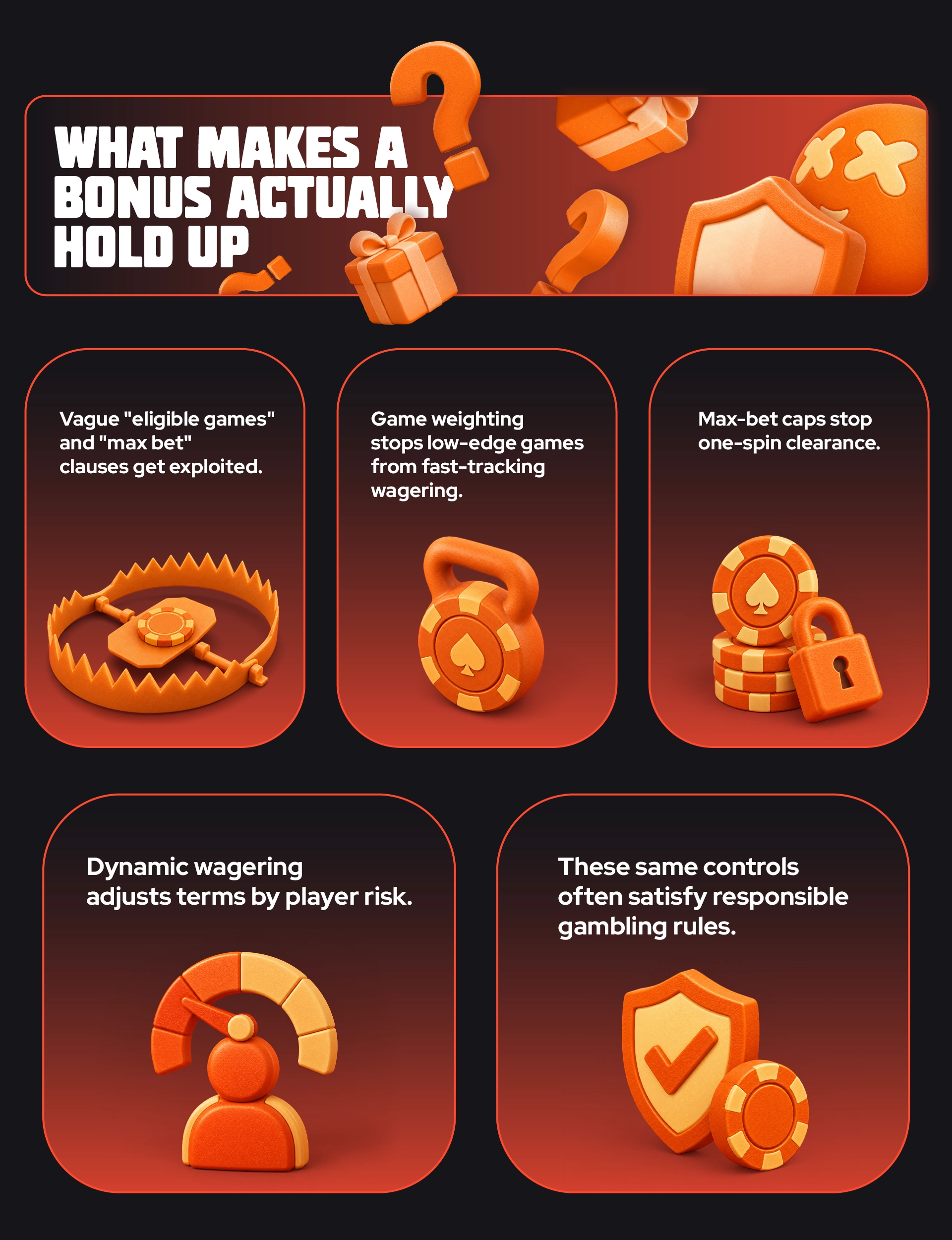
Two mechanics carry most of the enforcement load: game weighting, which reduces or excludes how much certain games count toward wagering, and max-bet caps, which limit stake size while the bonus is active. Together, they close the two most common ways a bonus gets cleared early.
Weighting Low-Edge Casino Games So They Don’t Fast-Track Wagering
- Games with a low house edge, like European roulette, certain video poker variants, and select blackjack tables, typically get a capped contribution toward wagering.
- This weighting needs to be spelled out on the terms page by game type.
Capping Bonus-Active Stakes to Prevent One-Spin Clearance
- Setting a stake ceiling while a bonus is active, either a flat amount or a percentage of the bonus balance, stops a player from clearing the entire requirement in a handful of high-stake spins or hands.
- This is a configuration choice made when the bonus is built, which is why it sits with the bonus/promo team from the start.
What This Means for Bonus and CRM Teams
- They carry most of the protection with the least setup work.
- Casino CRM can keep personalizing offers by segment; weighting and caps work quietly underneath the headline offer without changing what the player sees.
Flat wagering requirements apply the same multiplier to every player who claims a bonus, which makes them simple to build and simple to exploit. Dynamic wagering adjusts the requirement based on player-level risk signals, like deposit history or past bonus-clearing patterns, so a new or flagged account faces different terms than a long-standing one, without the casino publishing two separate offers.
What “Dynamic” Actually Means for iGaming Bonuses
- The advertised multiplier on the promo page stays fixed as the headline. What’s actually applied to an account can flex underneath it, based on that player’s risk tier.
- This runs on top of the segmentation CRM teams already do for targeting, so it doesn’t need new player-facing copy or a separate system.
What This Means for CRM and Bonus Teams
- Signals like a new account, a history of clearing bonuses right at the edge, or fast, repeated deposits become direct inputs into the wagering terms.
- This is the sharpest trade-off in bonus design: tighter terms for flagged accounts protect margin, but applying them too broadly to legitimate high-value players undercuts the relationship the bonus was meant to build.
What This Means for the Casino Website
Public bonus terms need a general disclosure, something like “wagering requirements may vary based on account activity,” even when the exact multiplier per player isn’t shown. That clarity is a compliance baseline for regulated iGaming operators.
Every control covered so far trades some headline appeal for a tighter bonus. Weighted games, bet caps, and dynamic wagering all read as slightly less generous next to a looser competitor’s offer. That trade-off is worth stating plainly, because it stops being optional once these same controls overlap with responsible gambling requirements.
The Appeal-vs-Risk Trade-Off
- A bonus with tight weighting, low bet caps, and dynamic terms will look less generous than a competitor’s looser one. That’s the honest cost of terms built to hold up.
- There’s no single “correct” setting. The right balance depends on operator size, market, and how much risk the business can absorb.
Where Bonus Controls Overlap With Responsible Gambling
- Max-bet caps and wagering limits that stop bonus abuse are often the same mechanics regulators expect for responsible gambling: deposit limits, loss limits, account-activity checks.
- Tighter bonus terms and stronger RG posture aren’t competing priorities. They’re frequently the same setting doing double duty.
What This Means for Bonus, Compliance, and Marketing Teams
- Any bonus-term change made for abuse control should be checked against RG obligations, and the reverse too.
- Marketing claims about bonus generosity need sign-off from whoever owns these settings, so the advertised offer and the enforced offer stay the same.
Getting these settings right, and keeping them right across every campaign, is what BetBoyz’ Bonus & Promotions Management service is built around: math-based configuration, lifecycle-mapped offers, and controls that protect margin without flattening player appeal.
If your bonus terms haven’t been audited since launch, that’s usually where the conversation starts. Talk to BetBoyz about Bonus & Promotions Management.
Enhance player loyalty with engaging bonuses and promotions. Betboyz crafts data-backed campaigns to keep your players coming back.
A bonus holds up when its enforceable terms get the same care as its headline number. Weighting, bet caps, and dynamic wagering are the three settings doing most of that work; none of them require rebuilding the offer from scratch.
Start with weighting and max-bet caps, the two that give the most protection for the least effort. Layer in dynamic wagering once risk segmentation is already in place. Treat every one of these controls as doing double duty: the same settings that stop bonus abuse are, in most regulated markets, what responsible gambling compliance already expects.