BetBoyz CRM Toolkit for AI-Powered Player Retention in iGaming
Player retention in iGaming has always come down to one question: are you engaging players on their terms, or on yours? The operators who want to get this right should work with systems that read behavioral signals early, respond with precision, and treat every player interaction as an opportunity to strengthen the relationship rather than just recover it.
That’s the premise behind this toolkit. AI-powered CRM should be the intelligence layer that makes automation work harder. When your data is connected, your risk definitions are sharp, and your actions are matched to context, retention starts becoming a competitive advantage.
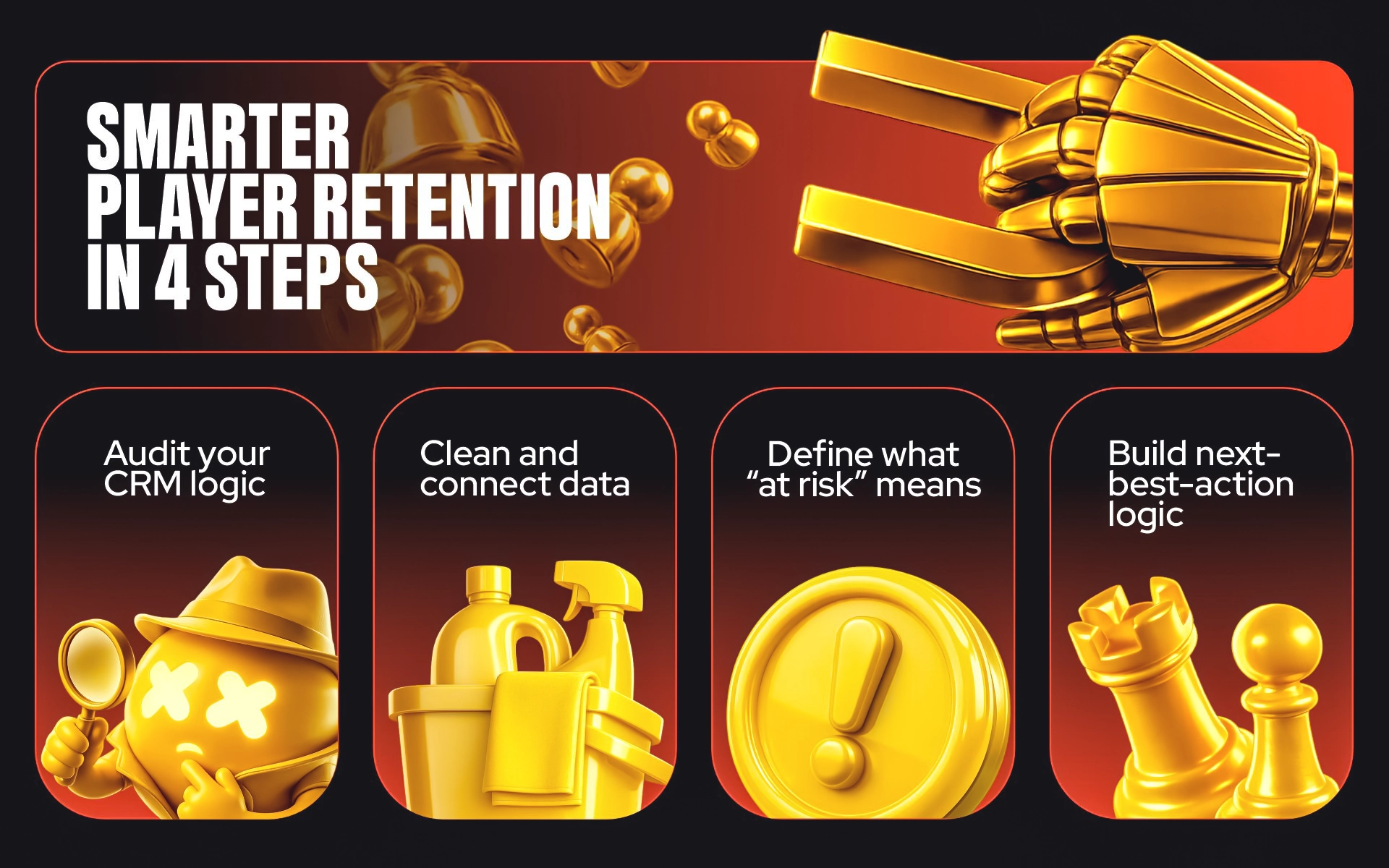
The four steps in this article build on each other. Each one addresses a specific layer of the retention stack, from auditing your existing logic, to cleaning your data to defining risk in a way that actually drives action.
A CRM audit is the foundation of any retention improvement effort, whether you’re refining existing flows, adding new channels, or exploring smarter integrations down the line. It gives you an honest map of what your system is actually doing versus what you intended it to do.
Over time, retention logic naturally accumulates: new flows get added, triggers get adjusted, and the overall picture becomes harder to read. A structured audit brings that clarity back. The goal is to trace your core retention journeys from trigger to outcome and understand how well your current logic reflects real player behavior.
How to do it
Go into your iGaming CRM backend and pull 3–5 of your core retention journeys from your CRM backend and map them manually from trigger to outcome. Look for patterns worth refining:
- The Inactivity Trap: Are flows only triggered by “days since last login”? Consider whether you can also trigger flows based on a drop in session depth, for example, a player who usually engages with 10 games in a session now only touches 2.
- The Bonus Loop: Does your system attach a promo code to most “at-risk” messages? Over time, this can condition players to expect an offer before they re-engage, which compresses margin.
- Segment Overlap: Are players with very different value profiles, like Casuals and VIPs, for instance, falling into the same retention flow simply because they share a 14-day inactivity trigger?
If a player is still logging in every day but their average bet has dropped from $5 to $0.50, they are at risk. But if your CRM only looks for total inactivity, it will stay silent while they slowly drift away. That’s a logic fail.
Good retention decisions are built on clean, connected data. Before any logic can work effectively, the information feeding it needs to be accurate, accessible, and unified across your key operational areas.
Player behavior lives across multiple sources, game activity, deposit history, bonus usage, and communication responses, and the value comes from seeing all of it together in one coherent picture.
The data points that matter most for retention aren’t necessarily the most complex ones. Login frequency, session length, deposit habits, withdrawal behavior, and channel response rates give you a reliable picture of where a player stands and where they’re headed.
How to do it
Start by connecting the dots that actually drive casino retention:
- The Basics: Login frequency and deposit habits.
- The “Vibe” Check: Session length and withdrawal behavior (if they’re pulling everything out, they’re done).
- The Reaction: How do they respond to your SMS vs. Push? Do they only click when there’s a bonus involved?
Once those connections are in place, check your operational setup. Does your CRM team actually have access to this data in real-time, or do they have to wait for a weekly report? You need a shared retention view like one single version of the truth that everyone (Marketing, BI, and VIP) agrees on.
Risk definition is what turns data into action. Without a clear, agreed-upon understanding of what “at risk” looks like for your specific player base, even the most sophisticated scoring system becomes difficult to act on. A risk score only has operational value when your team knows exactly what it means and what to do next.
Player bases are made up of distinct groups with different engagement patterns, deposit behaviors, and session habits. What signals disengagement for a VIP look very different from what signals it for a casual weekend player.
How to do it
Break players into groups such as New Depositors, Casuals, Regulars, and VIPs, and define danger differently for each:
- Casual Risk: They haven’t returned within their usual 3-day window.
- Regular Risk: Their session frequency is dropping (e.g., they usually play 4 times a week, now it’s once).
- VIP Risk: A sharp drop in bet size or a sudden stop in their favorite game.
Once you have the definitions, build a simple ladder of responses:
- Low Risk: Don’t annoy them. Just send a soft “check this out” content message.
- Medium Risk: A personalized nudge, maybe a game recommendation they’ve liked before.
- High Risk: A stronger intervention or a targeted offer to see if they’ll bite.
- High-Value/High-Risk: Skip the automation. This gets a personal touch from a VIP manager.
If your VIP misses their usual Tuesday deposit, that’s an urgent signal. If a casual player doesn’t log in for five days, they might just be busy. Using the same “churn” definition for both is how you end up wasting bonuses on people who don’t need them and losing the people who do.
We often find that the biggest hurdle is turning those risk levels into a workflow that actually makes sense. BetBoyz CRM team works with teams to map out these specific action levels, making sure the right player gets the right treatment at the right time.
Next-Best-Action (NBA) is a framework for deciding not just when to reach out to a player, but what kind of outreach actually fits their situation. It moves retention logic beyond a simple trigger-and-respond model toward something more contextual, where the action chosen is based on who the player is, what they’ve been doing, and what’s most likely to resonate with them at that moment.
The range of meaningful actions available to a CRM team is broader than it might seem. A well-timed game recommendation, a sportsbook cross-sell, a personalized reminder, or a message timed around a player’s usual session window can all be effective retention tools. The NBA framework gives your team a structured way to choose between those options rather than defaulting to the same response every time a risk signal appears.
How to do it
The logic should look like this:
- Detect the Risk: Use your data to see the change in behavior.
- Check the Context: Who is this player? Are they a high-value regular or a promo-hunter?
- Pick the Category: Does this situation call for a simple reminder, a game recommendation, a sportsbook nudge, or an actual incentive?
- Time it Right: Should this go out now, or should you wait until their usual Friday evening session time?
The most important thing to remember is that not every risk signal needs a bonus. Sometimes, a player is just “promo-tired” and needs less pressure, not more.
A player who is still logging in and browsing slots but has stopped depositing doesn’t need a discount yet; they might just be bored with the current selection. A well-timed game suggestion or a “new release” teaser is often more effective (and cheaper) than a stack of free spins.
Boost player engagement with tailored CRM solutions. From onboarding to retention, Betboyz ensures seamless management and personalized experiences.
The main goal should be to communicate smarter. Stronger retention comes from replacing rigid rule sets with logic that responds to how players actually behave.
Automation is a powerful tool, and its impact grows when it’s guided by sharper decisions. Moving toward AI-led CRM means shifting from chasing players after they’ve disengaged to engaging them while the relationship is still active. By aligning your data, refining your risk definitions, and prioritizing thoughtful action over reflexive discounting, you protect margin while building genuine loyalty.
Ready to sharpen your approach? BetBoyz helps bridge the gap between AI signals and real-world execution, partnering with you to build the journeys and logic that keep your players active for the long haul.