AI in Slot Game Design: Where It Helps, Where It Hurts
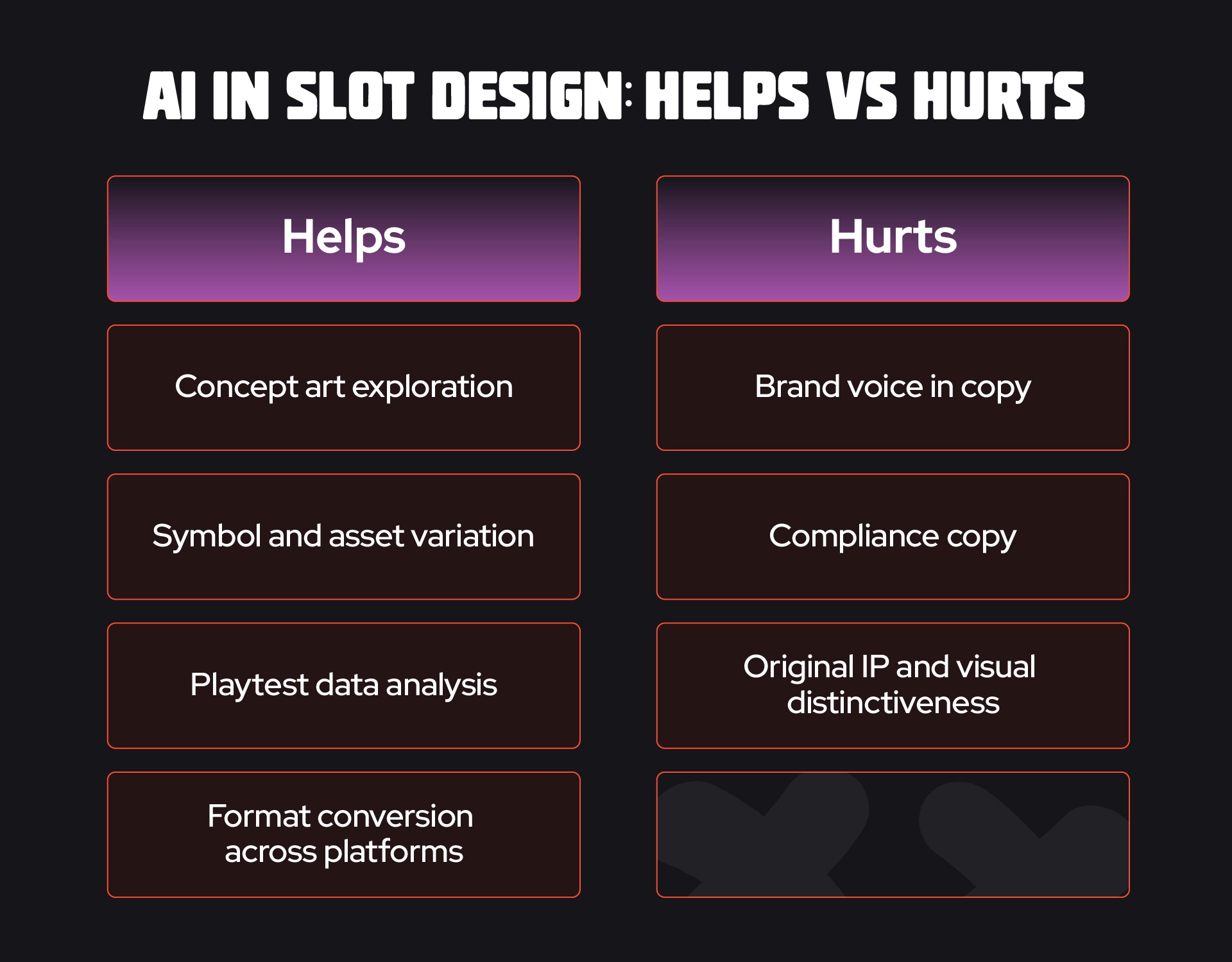
AI is now part of most slot production pipelines. Studios use it to explore themes in pre-production, generate symbol variants, draft copy, analyze playtest data, and convert assets across platform formats. The time savings are real, but they aren’t evenly distributed.
On repetitive, high-volume tasks, AI cuts production time significantly. On tasks tied to brand voice, regulatory language, or visual originality, it produces output that looks finished on delivery and underperforms once the game reaches players. The difference comes down to what each task actually demands: consistency within an established direction, or judgment that sets a game apart.
This article breaks down where AI earns its place in slot design, where it creates risk, and how studios split the work between AI and human designers.
Concept Art and Theme Exploration
In the earliest phase of a slot design project, pre-production, a slot’s theme, tone, and visual direction are decided. Traditionally, an art director works through mood boards, sketches, and early paint-overs before a direction locks, which can take weeks. Image generation tools compress that phase by producing large batches of directional references in hours.
A typical workflow looks like this: the art director defines a theme (say, a Mesoamerican jungle temple), then generates variations across lighting, palette, era, and rendering style. One batch might test dusk versus midday lighting, another painterly versus cel-shaded rendering, another jade-and-gold versus muted stone palettes. The strongest frames become the reference sheet that briefs the human artists who produce the actual game art.
The output is reference. It rarely holds up at final resolution; it often contains anatomical or architectural errors, and it carries no consistent style across frames. Its value is in narrowing the field faster. The real time cost shifts to curation: reviewing 200 generated frames to find the 10 worth briefing still takes a trained eye.
Symbol Variation and Asset Iteration
Slot games require many variants of the same asset, such as symbols across states, iGaming characters across poses, and backgrounds across moods. Generating these by hand is slow, repetitive work. AI handles it well inside a style-locked workflow, where the visual direction is already established, and the task is producing consistent variants within it. Non-hero assets are well-suited to this. Hero assets aren’t.
Hero assets stay with human artists. The main character, the bonus-round centerpiece, the wild and scatter symbols, and the logo carry the game’s identity and get the most screen time. They also go through the most rounds of feedback, which makes them poor candidates for generation. Generated assets also still need cleanup before they enter the animation pipeline, especially when symbols are rigged in skeletal animation tools like Spine, where layer separation and clean edges matter.
Playtest Data Analysis
Playtests and soft launches generate large volumes of event data: spin counts, session length, bet size changes, feature trigger rates, time to first bonus, and the exact point where each session ends. Reviewing this manually across thousands of sessions is slow. AI-driven analytics tools cluster player behavior, flag anomalies, and surface patterns that would take an analyst days to find.
Useful outputs include signals like: players who don’t trigger a bonus within their first 50 spins leave at a much higher rate; a large share of players skip the feature tutorial; bet size drops sharply after a long dry streak; or session length differs significantly between portrait and landscape mode.
Asset Preparation and Format Conversion
Modern slots ship in HTML5 across desktop, mobile portrait, mobile landscape, and tablet, often to dozens of operators with their own lobby and promotional asset specs. Each target needs correctly sized UI, repositioned reels and buttons, compressed textures, packed sprite sheets, and a set of marketing assets: lobby tiles, thumbnails, banners, and promo videos in multiple aspect ratios.
AI tools handle much of this reliably. Smart cropping and outpainting extend backgrounds for new aspect ratios. Upscaling models produce high-resolution versions from mid-resolution source files. Automated pipelines batch-export the operator asset pack in every required size and format. None of it involves creative judgment, and the time saved compounds with every operator integration.
Brand Voice in Copy
Slot copy covers more ground than most teams expect: game descriptions, feature explanations, paytable and help-screen text, bonus intro screens, lobby blurbs, and launch announcements for operators. AI can draft all of it quickly. The problem is what the drafts sound like.
Language models default to the statistically common phrasing for a given prompt. Ask for a slot description, and the output tends to open with lines like “Embark on an epic adventure” or “Get ready to spin your way to riches,” followed by “thrilling features” and “massive wins.” Every studio prompting for similar games gets similar copy. For a studio with a defined tone, whether dry, irreverent, cinematic, or minimal, these drafts need rewriting rather than editing, which often takes longer than writing from a clear brief.
Voice is one of the few brand assets in iGaming branding that is hard to replicate. Art styles, color palettes, and mechanics get borrowed quickly across the category. A consistent, recognizable tone across a studio’s whole catalog takes deliberate work to build, and AI drafts pull it back toward the category default.
Compliance Copy
iGaming operates under strict rules about player-facing language. Implied guarantees, promotional phrasing, and responsible gambling requirements vary by market and are defined by regulators, not by industry convention. AI drafts that look clean often fail these requirements in ways that aren’t obvious without market-specific compliance knowledge.
Original IP and Visual Differentiation
AI is a recombination engine. It generates content by finding patterns in what already exists and producing plausible variations. For a studio trying to build an online casino that looks like the category, that’s useful. For a studio trying to build a game that stands apart from it, AI is structurally limited. Originality requires deviation from pattern; AI optimizes for pattern.
The slots that build operator-level recognition, the ones players remember from a single frame, have a visual signature that isn’t interchangeable with anything else in the category. That signature doesn’t come from recombination.
The working pattern is asymmetric. AI handles high-volume, low-craft tasks: concept exploration, asset variation, copy drafting, playtest analysis, and format conversion. Human designers handle anything where brand consistency, voice, math craft, compliance, or originality is the actual deliverable. The split isn’t equal. AI handles more tasks in total, while humans handle the tasks that determine whether a game competes.
That split will shift over time. More tasks will move into the AI column as tooling improves. But the categories where human craft matters, math design, original IP, brand voice, and compliance, are getting more demanding as the market gets more saturated, not less. The studios positioned well aren’t the ones that adopted AI earliest. They’re the ones who know exactly which column each task belongs in.
At BetBoyz, that’s the casino branding framework we work from. AI in the pipeline, where it earns its place; humans are on the work that determines how a game performs. If you’re building a slot and trying to work out that split for your own project, see the work or talk to the team.
Bring your game ideas to life with Betboyz. Our creative team designs engaging, visually stunning games tailored to captivate your audience.
AI is a real production tool in slot design. It saves time on the right tasks and quietly damages output on the wrong ones. The studios getting the most from it aren’t the ones using it most; they’re the ones using it selectively, with a clear sense of where human craft is the actual differentiator.
That line isn’t fixed. The tooling will improve, the categories will shift, and some of what’s in the “hurts” column today will move. But the fundamentals, math feel, brand voice, original IP, and compliance aren’t moving fast, and they’re the ones that determine whether a slot competes or just ships.
Know which column you’re working in. The rest follows.