The iGaming Branding Framework BetBoyz Approves
The iGaming category runs on brand. Every iGaming business brand has to build trust fast through its name, logo, color, and tone, while staying consistent across different markets, each with its own restrictions and compliance rules.
To navigate the branding world with a clearer understanding while tackling your online casino business, we have decided to share some of our own strategies. This article walks through the seven stages of the BetBoyz-approved branding framework, from positioning and naming to visual identity, voice, brandbook, asset templates, and launch, showing how each stage builds toward one consistent brand.
A clear iGaming branding framework is a 7-stage system for building or rebranding online casinos and sportsbooks. It moves from strategic positioning through naming, visual identity, voice, brandbook, asset systems, and rollout, designed to produce a brand that’s consistent across every player touchpoint, from logo down to every brand detail.
The stages are effective when running in a fixed sequence because each one produces the inputs that the next stage depends on. The order isn’t a preference; it’s the mechanism.
- Brand Strategy & Positioning: define the audience, the competitive position, and the one thing the brand stands for. Everything downstream references this.
- Brand Naming: generate, pressure-test, and shortlist names that survive trademark checks, domain searches, licensing restrictions, and cross-market use. While also reflecting your brand’s full DNA.
- Visual Identity System: build the full design language: logos, color palette, typography, iconography, and imagery direction. The logo is one output, not the whole stage.
- Brand Voice & Messaging: set the tone, vocabulary, and sentence patterns, then apply them to real assets before anything goes to market.
- The Brandbook: document the entire system so every designer, marketer, and affiliate partner is working from the same rules.
- Asset System & Templates: build the template library that lets teams produce on-brand creative at volume without a designer bottleneck on every job.
- Rollout & Brand Governance: sequence the launch, train the teams, enable partners, and put in place the review cadence that keeps the brand consistent after go-live.
The sections below cover each stage in full: what happens, what gets built, and what goes wrong when it’s cut short.
Before a name, before a logo, three decisions need to be made: who plays here, what this casino brand offers that competitors don’t, and what trade-off it’s making. Getting these right first gives every later stage, such as naming, logo, and voice, a clear brief to build from.
Positioning
Positioning for a casino brand should answer one question: when a player looks at this brand next to five others, why would they pick it? It should be a specific claim about what the brand offers that a competitor doesn’t.
For online casinos and sportsbooks, that claim usually comes down to one of a few trade-offs:
- Payment method: crypto-first vs. traditional cards/bank transfer
- Tone: sports-serious vs. casino-playful
- Price point: premium/aspirational vs. accessible/mass-market
The output of this step is one sentence stating the trade-off this brand is making: e.g. “We’re the fast, no-friction crypto option” or “We’re the sportsbook for people who already read the line.” A real position rules something out; if the sentence could apply to any competitor too, it isn’t a position yet.
Audience
Audience is about behavior and motivation: what a player is actually looking for when they open the casino app. In iGaming, that usually splits by game type and mindset, not age:
- A crash-game player (Aviator, JetX, Plinko) is motivated by speed and social proof: short sessions, live counters like “1,240 players cashed out today,” meme-friendly language. The brand voice here works best fast and casual.
- An accumulator bettor building multi-leg sports tickets is motivated by control and expertise: stats, market depth, confident framing. The brand voice here works best precise and credible, closer to a sports desk.
Competitive Mapping
Competitive mapping is a visual audit of 5–10 direct competitors, comparing logo systems, color palettes, typography, and tone of copy side by side. It shows what’s already claimed in the market, so the new brand can pick a different lane on purpose.
A few things to do with it:
- Map the palette field: most casino brands sit in purple, green, or blue; sportsbooks lean navy and red. This shows which color space is open.
- Group by type register: bold/display type (common in slot and crash-game brands) vs. clean/corporate type (common in regulated sportsbooks).
- Cluster tone of copy: hype-driven (“huge wins”), informational (odds, stats), or playful (gamified), to see which tone is oversaturated.
- Check contrast standards: run palettes through WCAG ratios; bright accent colors over dark backgrounds (balances, bonuses, live odds) need to hold up on-screen.
Naming, in iGaming branding, means checking a name against regulatory and market rules before it goes on any shortlist. Every candidate name should run through linguistic checks, trademark searches across target markets, domain feasibility, licensing restrictions, and cross-market pronunciation, landing on a shortlist of names with written reasoning behind each one.
A casino name that clears every filter but sounds wrong in three target markets needs more work before it’s shortlist-ready. The same applies to one that’s available on .com but blocked by a licensing authority in a primary jurisdiction.
The Naming Brief
A naming brief is the short document that turns Stage 1’s positioning and audience work into naming criteria, the filter every candidate name gets tested against before anything is chosen. It typically states: the register (luxury vs. casual, crypto-native vs. traditional), the audience the name needs to land with, words or sounds to avoid (competitor overlap, regional slang, negative connotations in target languages), and the format the name needs to work in (short enough for a logo, available as a domain, workable across markets).
Generation
Generation is the stage where names actually get produced: a wide, deliberate spread of candidates across a few clear territories, tested against the naming brief.
- Linguistic patterns: invented words built from familiar sounds (e.g. “Betsson,” “Casumo”)
- Metaphor: imagery tied to luck, speed, or winning (e.g. “Jackpot,” “Rizk”)
- Coined terms: blends or compressions of real words (e.g. “Betssen,” a cleaner, more typographically flexible compression of an earlier name, “Bet Sensation”)
- Geographic anchors: place-based names signaling regional trust
Filters
Every candidate name runs through four checks:
- Trademark: searched across all target markets, not just the primary one
- Domain: .com availability plus relevant ccTLDs for target jurisdictions
- Licensing: MGA and UKGC both impose restrictions on gambling brand names; these vary by market
- Cultural and linguistic: pronunciation, connotation, and translation checks across player languages
The casino logo is the symbol and/or wordmark that identifies the brand: what players recognize instantly on an app icon, a homepage, or a payout notification. It’s one output of the visual identity stage, not the whole thing. The complete design language includes primary and secondary logos, color palette with tested contrast ratios, typography hierarchy, icon system, and imagery direction.
The Logo System
A logo system is a family built for different placements: primary logo, secondary lockup, app icon, monochrome version, single-letter variant (for favicons, app tiles, and loading screens). Each has a defined use case.
The Betssen rebrand required all of these: a soft rename from Bet Sensation meant the logo needed to carry enough of the original equity to retain existing players while signaling something newer and more considered. The Betkore build was the opposite brief, built from nothing, with a hieroglyph-inspired direction that informed the logo before a single vector was drawn.
Color & Typography
Color in casino branding does two jobs. First, it signals what kind of brand this is: green often reads “trustworthy/traditional,” purple “premium/nightlife,” red “urgent/high-stakes.” Second, it guides where a player looks first: the deposit button, a live odds change, a win notification. The palette is built as a system: primary, secondary, accent, neutral, with contrast tested from the start so balance numbers, bonus timers, and CTA buttons stay readable.
Typography uses two typefaces: one display face for logos, headers, and big numbers like jackpot counters, and one body face for terms, game rules, and footer text. Sizing and weight rules are set upfront, so every landing page, banner, and app screen pulls from the same scale.
Iconography & Imagery
Iconography is the small functional icon set: payment methods (Visa, crypto, e-wallets), game categories (slots, live dealer, table games), navigation (deposit, wallet, support). This stage sets the style: line vs. filled, sharp vs. rounded, so every icon matches.
Imagery is the photography and illustration used in marketing: banners, emails, social, app store screenshots. This stage sets the direction: real players vs. stock photography, moody vs. bright lighting, close-up chips/cards vs. lifestyle shots.
Defining both here keeps weekly creative consistent.
Copy is the one brand element players encounter at every single touchpoint: homepage headlines, push notifications, bonus terms, support emails. In iGaming, that means voice carries an unusual amount of weight. It has to work across highly regulated copy, casual marketing moments, and high-stakes transactional messages, often within the same player session.
The voice stage in iGaming branding defines tone, vocabulary, and boundaries before anything goes live, then tests all of it against real copy. The goal: one voice recognizable enough to spot without a logo, and durable enough to survive legal review, support tickets, and a marketing team writing banners every week.
Voice Attributes
Voice attributes are the 3–4 words that define how the brand sounds and act as a filter for every piece of copy that goes out. They should come directly from Stage 1: the positioning statement and the audience profile. A crypto-native brand built for speed and cultural shorthand needs different voice attributes than a sports-serious brand built for accumulator bettors who want credibility and depth.
A short, specific set of three or four words that each rule something out gives a copywriter something to check their work against.
Vocabulary & Sentence Patterns
This is the concrete rulebook underneath the attributes: a list of words the brand uses and words it avoids (e.g. “cash out” over “withdraw”), plus sentence-level rules: contractions or not, exclamation points allowed only in win moments, short punchy lines vs. longer explanatory ones. These are the rules that make a push notification (“Your bet’s live.”) sound like it came from the same brand as the homepage headline.
Applied to Real Assets
The voice gets tested on the actual copy it has to survive: hero headline, value prop, push notification, bonus T&Cs intro, support email signoff. Bonus terms are the real test, the most legally constrained, least flexible copy in the stack. If the voice attributes and vocabulary rules can carry a T&Cs intro and still sound like the brand, they’re tight enough to hand to an operations team writing copy every week without a strategist reviewing each piece.
A casino brandbook is the single reference document that turns every decision made in Stages 1–4, such as positioning, naming, logo, color, typography, voice into rules other people can follow without asking. It’s what a designer, a copywriter, or an affiliate partner opens when they need to build something on-brand without looping in the original strategist or designer.
As a casino brand scales across new markets and new affiliate partners, a growing marketing team, consistency stops happening on its own. The brandbook is delivered as both a PDF and a live Figma file, covering the entire brand system in one place.
What’s Inside
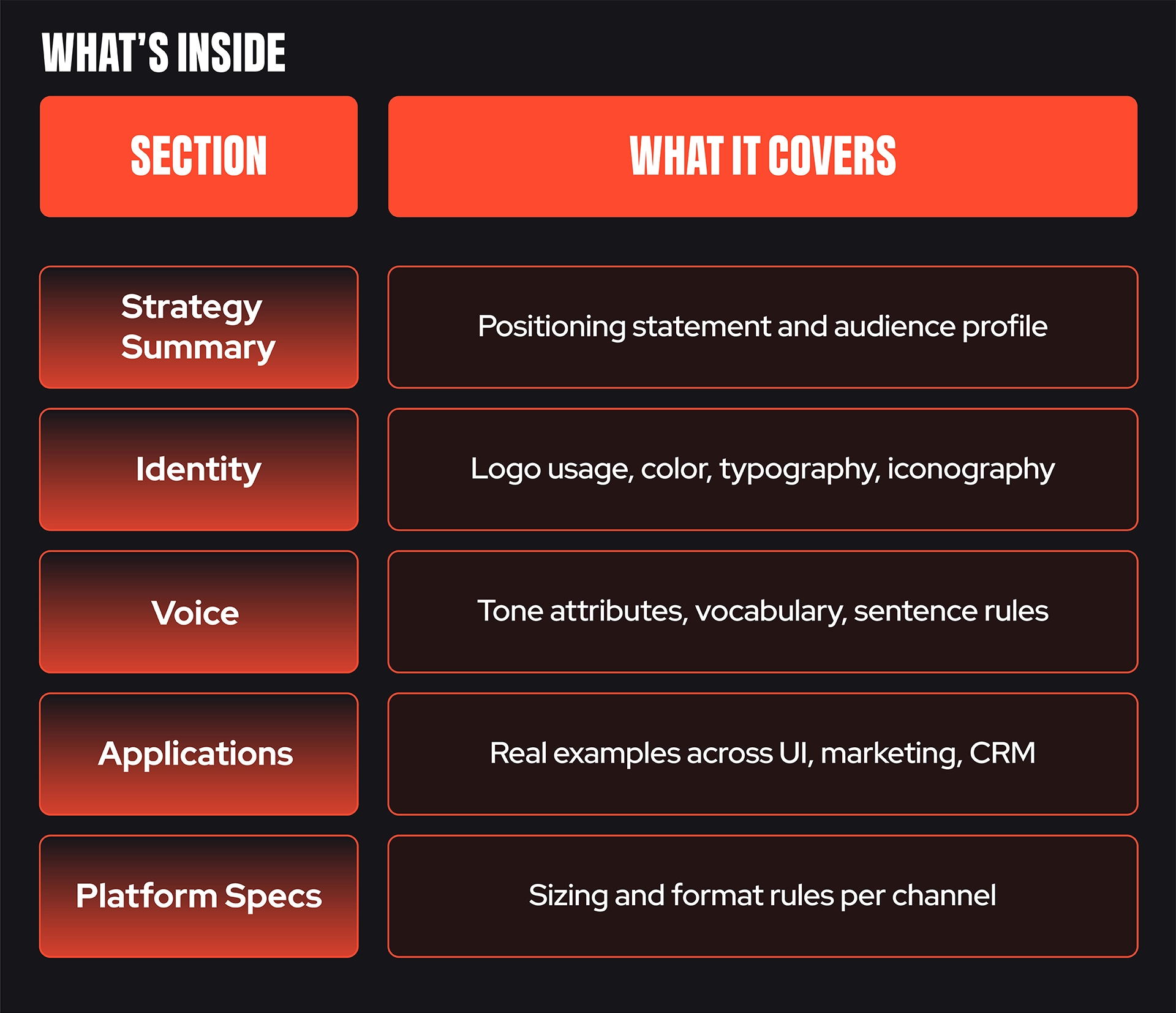
The do’s and don’ts pages get opened most by the most people, under the most time pressure. They prevent the majority of brand drift without requiring a designer in the room every time.
At operating scale, an iGaming brand produces assets constantly: a deposit-bonus banner for the weekend, a push notification for tonight’s match, a lapsed-player email, a landing page for a new slot launch. Without a template system, each one gets built from scratch, and quality depends on whichever designer is free that day. The asset system fixes this: a locked Figma library where logo placement, color, and type are fixed, and only the parts that change per campaign- bonus amount, game art, odds, CTA text can be left editable.
Bonus and promo banners get built first, because they’re produced most often (often weekly, daily during major sports events) and carry the most regulatory exposure, with bonus terms, wagering requirements, and required disclaimers all having to be present and correctly worded every single time.
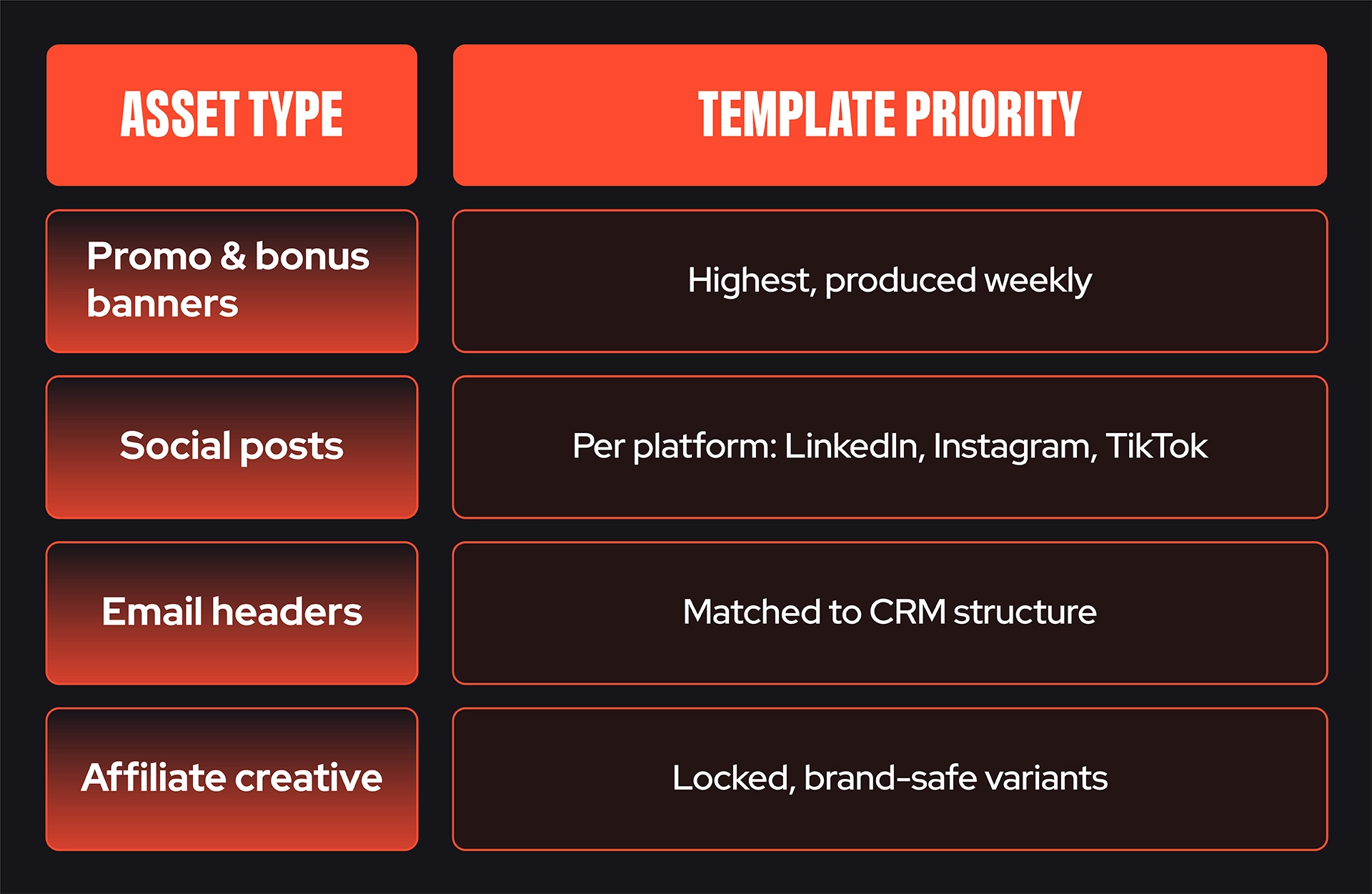
The result: a marketing team can turn around a same-day banner for a live match or a flash promo without waiting on design, and legal/compliance can trust that the locked template already carries the required disclaimer and correct terms; the only variables left are the ones that actually change.
Building the brand is the first half. Making it survive contact with the organization, support agents, affiliate partners, and CRM is the second. Rollout goes in order of player exposure: product UI and app first, then site, then social/paid, then affiliate creative last, since affiliates are hardest to control once live.
Training & Partner Enablement
Each team carries different risk:
- CRM (deposit and win-back emails) needs compliant bonus wording per market (UKGC vs. MGA requirements) alongside brand voice.
- Support (live chat, tickets) needs consistent tone across responsible-gambling conversations and routine bonus questions.
- Ops/Product (push notifications, in-app alerts) needs format rules for things like odds-boost alerts or deposit-limit reminders.
Affiliates get a separate kit: pre-approved banners, logo files, and a clear no-list, no unapproved claims like “guaranteed win,” no logo without the required 18+ badge, no missing “gamble responsibly” or license footer. Each affiliate should confirm the required badges and footer are present before a banner goes live.
Governance Cadence
Quarterly reviews, an annual brandbook update, one named owner. The check: are affiliate banners still carrying the license number and responsible-gambling footer, does CRM copy match local disclaimer rules, is the logo only on approved backgrounds, does support’s tone still hold. When those appear, the review cadence catches them before they require a full rebrand.
If your casino brand is due for this kind of connected system, or a check on whether the one you have is actually holding up, BetBoyz builds and audits iGaming brand identities end to end, from positioning through rollout.
Visualize and bring to life the craziest branding and design ideas with with our wizards.
Good casino design gets a brand noticed. What keeps it together across markets, channels, and years of operations is what sits underneath: a real brand position, a defined audience, and a system that connects every piece back to those two decisions.
That’s the seven stages: positioning and audience set the direction, naming and logo give the brand a name and a face, voice gives it words, the brandbook puts the rules in one place, the asset system lets teams produce at volume, and rollout/governance keep it consistent after launch.
Building or rebranding? See the studio’s branding work or brief the team.