
iGaming Website Management: Why a Slow Casino Site Loses Players
A player doesn’t complain about a slow casino site. They just close the tab and don’t come back. No support ticket, no feedback form, just one less session, one smaller deposit, one player who moves on to a platform that loads faster.
Website performance shapes that decision every time it matters most: loading a favorite game, moving through the deposit flow, checking a balance on mobile. When those moments lag, retention drops before anyone connects the dip to page speed.
This article maps that connection directly. It covers the performance signals that actually predict player drop-off, how those signals should route to the right team, where context still matters before a fix gets escalated, and which metrics prove the work paid off instead of just generating more alerts.
Drop-off from a casino website rarely starts with a player abandoning the platform outright. It starts with small friction points days or weeks earlier: slower loads on high-traffic games, an extra step in the deposit flow, a mobile experience that lags behind desktop. These friction points are what site performance tracking is built to catch.
Early symptoms in raw activity:
- Slower page load times on popular games or landing pages, relative to a player’s expectation or the platform’s own baseline
- Deposit flow friction: extra steps, delays, or errors between choosing to deposit and completing the transaction
- Mobile performance gaps, where load time or responsiveness trails desktop, often unnoticed until mobile sessions are reviewed separately
The signals that turn friction into a measurable pattern:
- Page load time by device and page type
- Deposit and withdrawal completion rates
- Uptime and error rates during peak traffic
- Session abandonment tied to specific pages, not the site overall
For iGaming CRM and retention teams, the symptoms above are visible without a technical audit; they show up as unexplained dips in deposits or session length. The signals above are what product and dev teams formalize into monitoring; CRM input on which pages correlate with drop-off keeps that monitoring focused on player impact, not just uptime.
Spotting the signal is only step one. What happens next (who gets alerted, and how fast) decides whether that friction gets fixed or just gets logged.
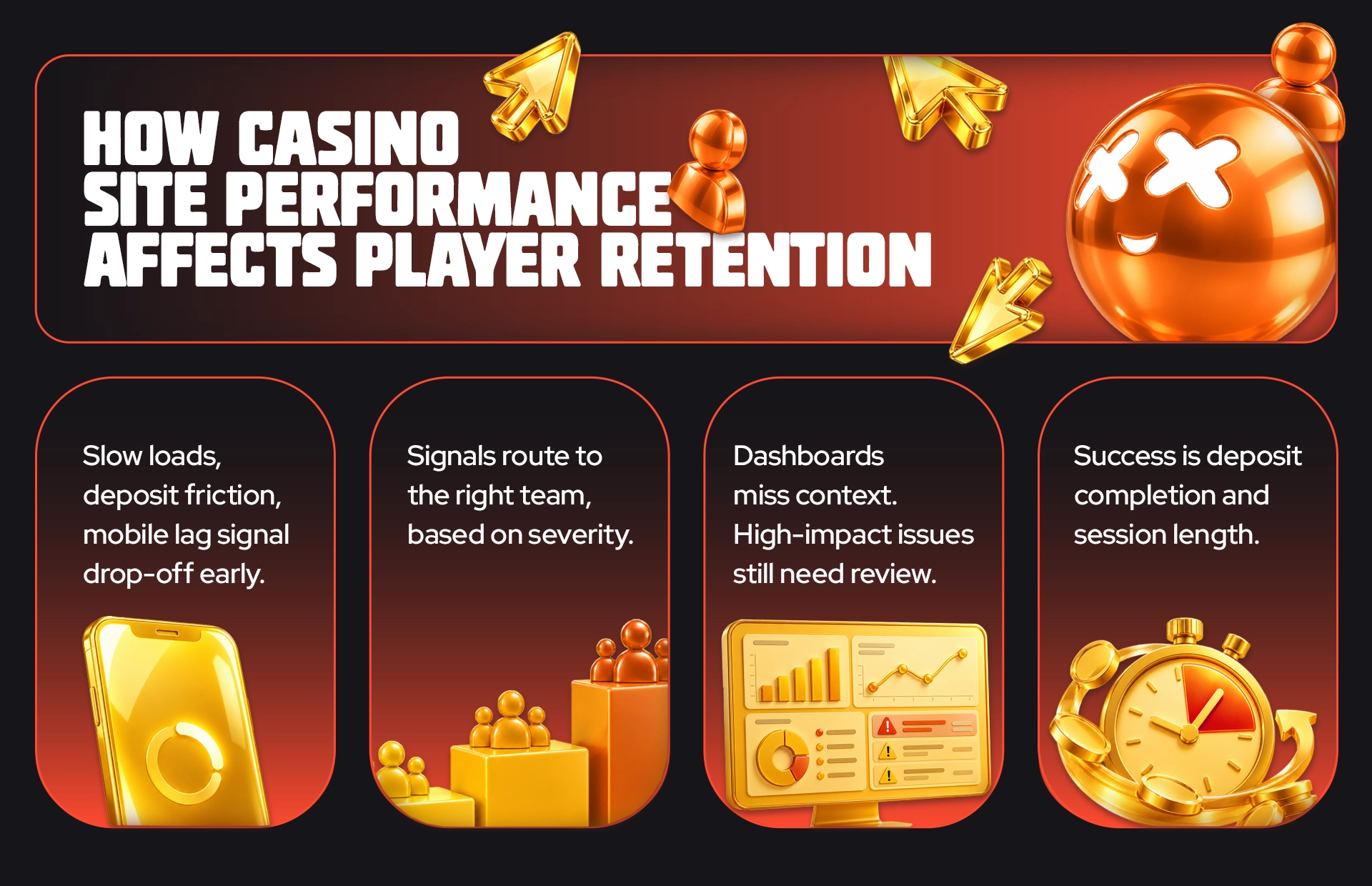
A performance signal is only useful once it maps to an owner and an action. A slow image on a low-traffic page doesn’t need the same response as a deposit page timing out mid-promotion. Treating every dip the same wastes both dev time and campaign budget.
Severity should decide the response, not the alert itself:
- Low severity: minor load delays on low-traffic pages. Log it, review it on the normal dev cycle, no escalation needed.
- High severity: friction on deposit, withdrawal, or core game pages. This gets prioritized dev attention, and where relevant, a pause on campaigns driving traffic to the affected flow until it’s resolved.
- Peak-traffic risk: uptime and speed under load during promotions or major events. This calls for pre-emptive load testing, not a reactive fix after players have already bounced.
Routing works best as a shared decision, not a one-team call. Performance monitoring supplies the signal; casino CRM and product decide what actually counts as urgent, based on which pages and moments touch conversion.
But not every dip in the data points to an underlying site issue. And knowing the difference is where the next checkpoint matters.
A performance dashboard reads load times and error rates, not player intent. It can’t tell a genuine site problem from a traffic spike caused by a successful campaign or a regional connectivity issue. Reviewing data against context is what keeps fixes targeted at the real cause.
Traffic spikes that mimic a performance problem
A successful casino promotion drives a surge in visits, and the resulting slowdown looks identical to a genuine performance issue in raw load-time data, even though the real “fix” here is nothing more than the campaign doing its job.
Regional issues outside the platform’s control
A connectivity problem tied to a specific region or ISP shows up as site slowness in the numbers, but sits entirely outside what a platform fix can resolve, no matter how fast the dev team moves.
Why a context check belongs before escalation
This doesn’t mean reviewing every fluctuation by hand. It means gating the moments where campaign timing, regional traffic, or a known external event could explain the dip better than a broken deposit flow does. The trade-off is worth naming plainly: fast escalation catches real problems quickly, but it also risks responding to signals that were never the platform’s to fix.
Which raises the actual test of whether any of this is working, not how many alerts fired, but what those alerts actually protected.
A fix isn’t proven by a better load-time score. It’s proven by what players do afterward. The real measure is retained session length and deposit completion rate, not how many alerts got logged or resolved.
The metrics that actually matter
- Deposit completion rate: the share of started deposits that finish without abandonment tied to site friction
- Session length relative to baseline: whether players stay engaged at the same rate once a fix ships
- Alert volume: worth tracking, but as a cost metric, not a success metric
Why over-alerting undercuts the whole system
Fluctuations flagged as problems that were really traffic spikes or normal variance reduce confidence in monitoring over time and make it harder for teams to know which alerts genuinely need attention. Confidence thresholds and context checks against known campaign events keep the system precise instead of merely loud.
The review habit that makes it stick
Deposit completion and session length should be reviewed together, on a recurring cadence, with alert volume treated as a tuning input rather than a workload target. A smaller, well-targeted alert list beats a wide one flagging fluctuations nobody needs to act on.
This is the kind of review BetBoyz’s website management team builds into ongoing CRM work: checking whether a fix moved the numbers that matter, not just the ones that are easy to log.
Get a full-cycle operational support for your iGaming business from CRM to Media Buying & PPC.
Site speed shows up as a retention signal long before anyone labels it that way: in deposit numbers, session length, and how often players come back. Catching that signal early, while it’s still just a load-time delay or a deposit-flow hiccup, is what keeps it from turning into a churn number.
That’s the case for treating website management as an ongoing retention discipline. The signals are already there in page load times, deposit flow completion, and mobile performance. The work is routing them to the right team, checking them against context before escalating, and measuring what actually moved: session length and deposit completion, not alert counts.