
The Future of Online Casino Payments: What’s Changing in 2026
Online casino payments are changing in 2026, and players feel it before operators do. Cards still work. But more players now pay with a local bank transfer, an e-wallet, or sometimes crypto. It’s how they already pay for everything else. Withdrawals used to take a day or two. Now they happen in minutes, for operators set up to deliver that. Open banking lets a player pay straight from their banking app.
This reaches beyond the payments team. Marketing does best when it checks which methods are live in a market before spending there. CRM can treat fast, reliable payers as a segment worth extra attention. Bonus terms work best when they state clearly which methods qualify.
This article covers each of these shifts, what they mean for marketing, CRM, bonus, and website teams, and what’s realistic to act on at an operator’s size.
Cards are still standard at checkout. But they’re no longer the only method players reach for. Local bank transfers, e-wallets, and crypto now sit alongside cards, because players already use those methods for everything else. The cashier page has to work for that wider mix, market by market.
Why Players Are Considering Other Payment Methods
Players expect the casino cashier to work the way their other daily payments already do. Card performance plays a part too. Gambling transactions get flagged differently by issuing banks, causing declines even on valid, funded cards, friction the player reads as “this site doesn’t work,” not “payment failed.”
The mix isn’t the same everywhere. Pay by Bank and Trustly-style transfers lead in the UK and Nordics. Blik is close to default in Poland. MB WAY matters in Portugal, iDEAL in the Netherlands, Interac in Canada. There’s no single method to add, the right list differs by market.
What This Means for Marketing and the Cashier Page
- A campaign can have the right audience, message, and budget and still underperform if the player doesn’t see a trusted method at the cashier.
- Check what’s live in a market before spending there.
- Name the method directly: “We accept Blik” beats “fast, secure payments”, a claim players can verify at a glance.
- Sort methods by market, local option first, cards below. One setting, consistent lift.
- Review the mix on a schedule, adoption shifts fast once a major local bank integrates a method.
- New market entry should trigger that review automatically, marketing and website together.
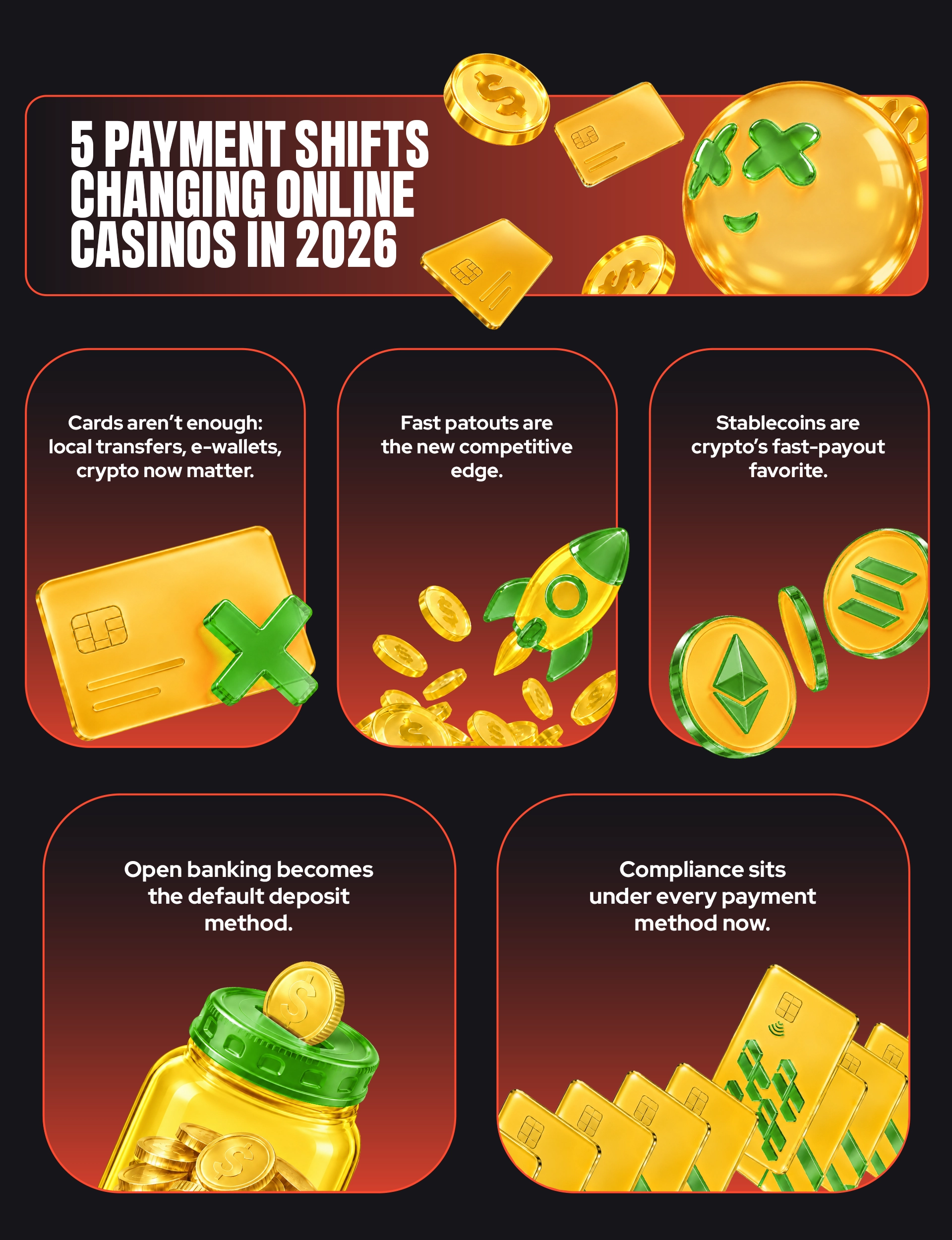
Payout speed used to be an internal metric, tracked by ops and rarely mentioned outside it. Now players compare it directly between operators, the same way they compare bonuses. Instant and near-instant payouts are becoming the norm, but KYC and AML checks still have to run before any payout, so “fast” means cutting everything except those checks.
Why Payout Speed Now Matters
A slow withdrawal makes a player wonder if they’ll get paid at all, it’s the most trust-sensitive step in the relationship. Players now compare payout speed between operators the way they compare bonuses, and it’s become a real reason to churn. Instant payouts only happen where the process is built for them.
What This Means for Marketing and CRM
- Don’t advertise “instant payouts” without the ops process to back it consistently. A broken promise here costs more trust than never making the claim.
- Fast, reliable payers are a flaggable retention segment. CRM increasingly tracks this as a loyalty signal, but few teams act on it.
- Shorter time between cashout and redeposit is a real loyalty indicator. Worth watching, not just recording.
What This Means for the Website
- Withdrawal flow deserves the same design attention as deposit flow. Most teams polish one and leave the other untouched.
- Support and payments-ops staffing need to keep pace, especially around manual review thresholds.
Crypto isn’t replacing cards or bank transfers, it’s a growing add-on, mostly used by cross-border and high-value players. Stablecoins (USDT, USDC) now drive most of that activity, because they move fast without Bitcoin’s price swings. For CRM and bonus teams, crypto players behave differently and often need different rules.
Why Stablecoins, Specifically
- Stablecoins keep crypto’s main benefit such as near-instant transfer without the volatility that made gambling with Bitcoin awkward.
- They’ve overtaken Bitcoin’s earlier lead in crypto wagers as players shift toward stability over speculation.
- Operators can plug stablecoin volume into existing crypto-to-fiat processors without holding volatile crypto themselves.
What This Means for CRM, Marketing, and Bonus Rules
- Crypto players deposit more, expect faster service. Treat them as a distinct CRM segment.
- Keep crypto messaging separate from mass-market copy.
- Sharpest bonus-abuse risk here: fast payouts let a player deposit, claim, and cash out before anyone catches the pattern.
- Tighter wagering and withdrawal limits on crypto bonuses than fiat.
- State plainly whether crypto deposits qualify. Left vague, it’s a dispute CRM resolves by hand.
Open banking lets players pay straight from their bank account through a secure connection with no card details needed. It’s becoming the default deposit method across regulated Europe, and it hands operators verified financial data that supports compliance checks, a rare case where payments and compliance solve each other.
What Open Banking Actually Does
The player approves a payment straight from their banking app, no card numbers, no waiting for a transfer to clear. With consent, the same connection can share verified account data to support affordability checks. Deposits and withdrawals both run through this one bank-linked connection.
What This Means for CRM and the Website
- It’s cheaper than cards and removes chargeback risk entirely.
- New EU rules are pushing banks toward instant transfers as standard.
- On the website, it’s usually a simpler checkout than cards: fewer fields, fewer failed payments, a conversion lift with no design overhaul.
- The same account data that speeds up deposits can feed affordability and responsible-gambling checks.
- Coverage still depends on the market: strong in the UK and EU, earlier-stage elsewhere.
Which payment methods an operator can offer should now be a compliance choice first. Every method, from cards to stablecoins, needs identity checks and transaction monitoring before it goes live. That limits what marketing can promise, what bonus terms can allow, and what CRM can act on. KYC and AML aren’t optional add-ons; they’re built into every method. Deposit limits and affordability checks apply the same way across all of them, not just cards.
Licensing decides what’s even allowed market by market, and EU rules are tightening those checks through 2026 and 2027, crypto especially. Claims like “instant” or “fully private” need compliance sign-off before they hit ad copy. Bonus terms need to match each method’s real limits. And a new market means checking compliance fit before checking popularity.
Payments now shape trust, conversion, and retention as much as any other part of the player experience, which makes the cashier page a design and product decision, not just a technical one. That’s the layer BetBoyz works in: building iGaming platforms where every part of the experience, payments included, is built to earn trust.
Payments in 2026 aren’t a back-office checkbox. They’re where trust gets won or lost: in the method mix, the payout speed, the crypto option, the open banking flow, and the compliance behind all of it. Every team touches this, not just payments. Reviewing the setup on purpose, rather than reacting to a competitor’s faster payout, is what keeps an operator ahead. That’s the thinking BetBoyz brings to every platform it builds, payments included.