iGaming Design Trends We’re Tracking in 2026
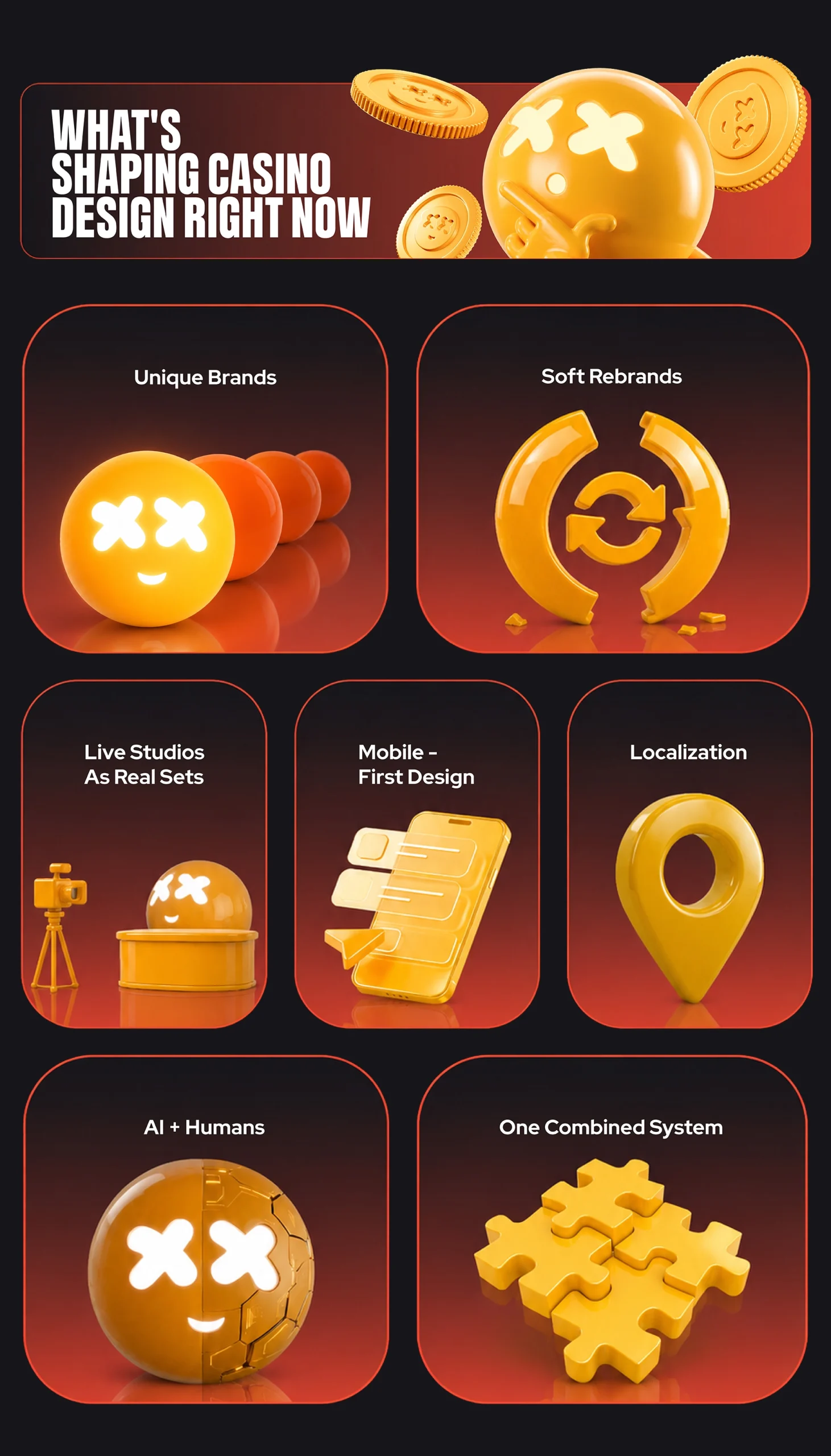
If you’re briefing branding, live studio, or game design work for an online casino in 2nd half of 2026, these seven shifts are worth watching. Live casino studios are shifting from functional sets to fully themed destinations built to hold up on stream. Design is moving from desktop-first thinking to portrait mobile as the true starting canvas. And branding, game design, and live studio are increasingly being perceived as a connected system.
And those are just three of the seven iGaming design trends that this article explores. Let’s see what’s driving each one, and how they’re playing out in BetBoyz’ real projects: BetKore, Betssen, Express Roulette, mylo.
A growing pattern in casino branding is a clear requirement for visual distinction, something that stands apart from the default look of the category. Operators with real player bases are recognizing that brand memorability requires going further visually than the category has traditionally allowed.
What’s driving it:
- Player-facing casino lobbies are increasingly hard to tell apart
- Operators expanding into new markets need visual anchors that travel
- Brand recall is becoming a measurable retention factor, not just an aesthetic choice
BetKore is the clearest example. The aim was to create a brand that wouldn’t resemble any other casino in the category. The result was a hieroglyph-inspired visual identity, and a system that gave the brand genuine distinctiveness without relying on iGaming conventions.
Established operators with existing player equity are choosing to evolve their casino brand rather than replace it. A soft rebrand keeps what’s recognizable, and updates the visual energy and positioning. It preserves what players already know while moving forward with the brand.
When it works:
- The existing brand has real player recognition worth keeping
- The update is about modernizing the visual language, not resetting the identity
- The casino brand rename, if any, stays within the same brand family
Betssen (formerly Bet Sensation) is a clear example of this trend in practice. The brief required keeping established brand recognition while shifting the visual direction toward a technological, forward-looking aesthetic. The rename compressed the brand name without breaking continuity.
Live casino studios are no longer functional sets with a neutral background and a dealer. The current generation of briefs treats the studio environment as a brand asset, a spatial identity that needs to hold up on stream, in marketing, and across partner co-branded content. The investment is higher, but so is what the environment produces.
What spatial studio design now covers:
- 3D visualization and technical drawing before building
- Ambient details: lighting, graffiti, surface textures
- Engineering management through the physical build
- Stream-ready visual identity
In the work: For the Express Roulette project, the brief called for two roulette tables. BetBoyz Studio delivered a full cyberpunk environment instead: the graffiti on the walls, neon lighting and contrast, even a sense of a buzzing city just outside the windows. Every detail was built to carry the feel, turning a functional set into a live brand destination.
Mobile-first is no longer a design principle studios apply in principle and override in practice. In 2026, briefs arrive specifying a portrait phone as the primary canvas. Desktop is adapted from there, not the other way around.
What changes when mobile is genuinely a priority:
- Portrait reel grids and thumb-reach UI are locked before desktop layouts
- The responsiveness is an ultimate must
- Content is adopted while keeping a mobile-first approach
The mobile-first casino website methodology is now applied to every slot and UI/UX project at BetBoyz. The canvas shift changes the design sequence in ways that surface problems earlier and reduce rework later.
Operators expanding into new geographies are discovering that a visual identity calibrated for one market doesn’t automatically travel. Color associations, typographic conventions, and imagery direction carry different meanings across regions.
Where this matters most:
- LATAM, MENA, and APAC expansion can sometimes feel misaligned
- Market-specific imagery decisions need to be made at the brand level, not just campaign level
- Consistent brand architecture that defines what changes per market and what stays fixed
Color psychology in igaming reveals how the same hex value can carry different weight across markets. The trend implies thinking at the full identity level, not just the palette.
AI is being used across studio production. In 2026, the question is not whether studios use it; it’s how the split is managed between what AI handles and what stays with experienced designers.
How it should work in practice:
- AI: asset preparation, speeding up some automated processes, etc.
- Humans: brand voice, final creative decisions, making your igaming business stand up
The split is asymmetric. Volume tasks move faster with AI assistance. Creativity-sensitive work, anything that defines what makes a brand or a game distinct, stays with the team.
The most coherent operators in 2026 are treating branding, game design, and live studio design as a connected system rather than separate scopes. A unified system(as much as it applies to your igaming business) boosts credibility, trust, and recognition.
What a connected system requires:
- One visual language across brand identity, UI, and other aspects of your brand
- Design decisions made with all surfaces in view, not adapted after the fact
- A studio capable of delivering across all four without handoff gaps
Mylo by Betboyz is the cleanest example of a full brand system built as one scope. BetBoyz led the entire project, from brand core and naming through visual guides and brand book, shaping every detail so Mylo reads as a fun-loving caregiver. The BetBoyz studio is built around exactly this: branding, game design, live casino studio design, and UI/UX as one connected system.
Visualize and bring to life the craziest branding and design ideas with with our wizards.
These seven shifts share a common thread: casino design in the 2nd part of 2026 is getting more deliberate, more distinctive, and more joined-up, whether that’s a brand refusing to blend in, a live studio built to double as a marketing asset, or a single team carrying one visual language across every surface a player touches.